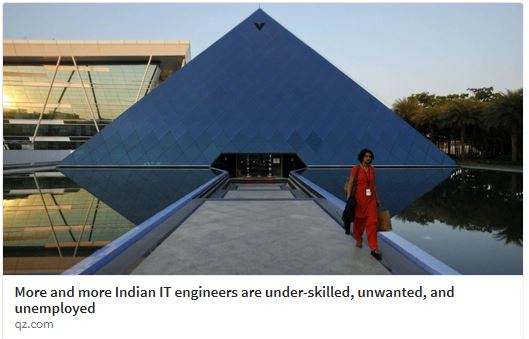
I saw this Quartz article—More and more Indian IT engineers are under-skilled, unwanted, and unemployed— earlier today and although it involves a bunch of people I’ll probably never meet, in a country I’ll probably never visit, this piece bothered me on a fundamental level. It reminded me of something that I learned decades ago about an inevitable consequence of economic evolution, a consequence that renders large groups of people irrelevant, invisible, and forgotten.
I first entered college, sometime after the earth cooled, as a student of economics. That changed quickly enough, but not before I had completed several seriously enlightening courses in that discipline. At least some of what I learned from my esteemed professors, for better or worse, has stuck with me to this day. The above-linked article reminded me of this. Let me explain.
Economic evolution/revolution has always opened doors for some and slammed them shut for others. Consider the transitions from agriculture to industry, from industry to service, from service to information, and from information to (smart) automation. That last transition is still unfolding. In fact plenty of people either don’t know about it yet or are in denial—but that’s a topic for another time. My point is this: with every turn of the wheel, opportunities have opened and opportunities have closed. Each and every time, while traditionally understood job opportunities shrunk, new and exciting job opportunities expanded, albeit not always at the same rate. Maybe never at the same rate.
What happens when the only job role you’ve ever known becomes obsolete? On a purely academic level, the answer is simple: people must be retrained.
But even the citizens of academia will readily admit that not everyone can be retrained and funneled into the revised economy. Why? For openers, there will likely be fewer new jobs created than old ones eliminated. Second, who is going to pay for all this retraining? Finally, consider also that some individuals may be too close to retirement to start over—but not close enough to be able to retire.
If you haven’t already done so, please take a few minutes to read the article to which I referred earlier. Check out the prediction that “3.9 million employees of Indian IT services companies would become ‘irrelevant’ within the next four years” due to automation. And don’t overlook the prediction that 65% of the displaced workforce cannot be retrained.
That seems like an awful lot of people to disregard as irrelevant. Irrelevant! We aren’t talking about an obsolete screw that will no longer be used to manufacture a product. We aren’t talking about a line of code in a software program that is no longer needed. These are people! Human beings! When they disappear on paper, when they drop from the statistics, when they are no longer visible in the economic model, what do you imagine happens to them?
I am reminded of a 1993 movie called Falling Down, starring Michael Douglas. There is a scene in which Douglas’ character encounters a man protesting in front of a bank, raving about having become “not economically viable.” During this scene, the raving man is arrested and taken away by law enforcement officers. What is often lost on the audience is the fact that the man carted off by police is dressed identically to the anti-hero of this story.
Of course it doesn’t take an economic revolution to cause this condition. We see the same thing happen on a smaller scale whenever an economic downturn occurs. Or smaller yet when a specific industry falters. Or smaller yet, when this or that company is forced to “downsize” in order to remain viable.
This happens every day. I have witnessed it firsthand, on varying scales, for decades. As an educated man, I am capable of understanding and explaining the whole cause-and-effect episode. As a wordsmith, I can spin things toward a specific desired outcome.
Just remember one thing. No matter how we slice, dice, or spin a given situation, these are human beings we are talking about. Okay?
How would you like to be called irrelevant? I thought so.
I know this post has been a bit of a departure from the things about which I usually write. With that in mind, if you are still reading, thanks all the more for hanging with me.

 Let me tell you how it worked in high school. I had this chemistry class scheduled immediately after my lunch period. It so happens that a buddy of mine had the same class and the same lunch period as me. Every time we had a chemistry quiz or test scheduled, I would walk into the cafeteria and find this poor guy sitting with his nose buried in his chemistry textbook, sweating bullets. He would sit there, turning the same pages over and over and looking as if he were about to go before a firing squad. I could get acid indigestion just watching him. So I woul reach out.
 That’s how I learned chemistry. I spent my entire lunch period explaining the most difficult parts of every chapter to my friend—without missing a bite, I might add—and then proceeded to ace every chemistry quiz and test that followed.
 Yesterday I had finished developing a proposal for a potential new customer and while everything looked fine to me, I know that at times I can be my own worst proofreader. So I asked an associate to review my work. But rather than just email the documents and hope for the best, I opened them on a large display and asked my colleague to let me walk him through my steps.
 I can recall times long ago, when my own kids would be struggling with a subject in school. Sometimes it would help to let them talk in detail about the subject or the issue. They are adults now, as am I, and there are times when each of us may still benefit from the same approach.
 This Is MGD Time