
From the moment I began teasing my Facebook friends with photos about the pot of chili I was making, inquiries and recipe requests began flowing in. And while I do boast about having certain secret ingredients in my various dishes, truth be told, I’m not all that secretive. There was only one problem: I seldom do recipes and my signature chili is definitely no exception. But I did promise a few people that I would write this article — to give them my non-recipe if you will — and I am a man of my word. So here goes.
For openers, let’s talk about the main ingredient in most chili recipes: the meat. Most chilis I have eaten, some of them extremely good, were made with finely ground meat. There’s nothing wrong with that. Heck, my own mother used hamburger meat (usually ground round) to make her chili. I used to do likewise until I discovered alternative methods. Some years ago, I was in downtown Indianapolis for a conference. A handful of associates and I decided to visit a chili bar for supper one night. We were doing sampler trays and at some point, I realized that the chili I was eating had not been made from hamburger but from finely chopped solid meat. This epiphany forever changed the way I make my chili.
My go-to meats are steak and lean pork, which I usually dice by hand. This takes time but the results are great. Now stop a moment and think about the sheer number of alternatives that can be found in that one sentence alone. Do I have to use beef and pork? Heck no. You can use any number of meats, alone or in combination. I have done many chilis using only beef. I have eaten very good chilis made using only chicken, only pork, and in one case, no meat at all. My friend Ann and I once made a phenomenal chili using lean pork and chicken thighs. I have friends who make venison chili and one who has even used squirrel meat. I’ve not tasted either, nor do I judge, but these variations further serve to illustrate the sheer depth and breadth of possibilities.
You don’t necessarily have to cut the meat by hand, either, although that method will give you the greatest amount of control over the size and shape of your cut pieces. Do you have a food processor? I have had good results using my ancient La Machine food processor to do my coarse chopping. You just have to be careful not to end up with puréed meat. A meat grinder with a coarse grind option will also work nicely. That’s what Ann and I used when we made our pork and chicken chili.
At this point, I am ready to season and brown my meat. While preheating my pan, I will season my meat while it is still in a bowl or spread out on my cutting board. Here is where I apply kosher salt, coarse-ground black pepper, cayenne pepper (coarse or fine, your choice), and a favorite meat seasoning or rub — which in my case is Mike’s All Purpose Seasoning. No, I am not the Mike who developed this line of seasoning products, but I did meet him once.
If I have concerns about grease, I may opt to brown my meat in a skillet and then transfer it, sans all the extra grease, to my chili pot. I typically use lean cuts of meat, though, in which case I’ll prepare the whole gig in one pot. I start with a hot pan, add a little peanut oil (prized for its high smoking point), and brown the meat over high heat so as to burn off all the water that will come from the meat as it cooks.
As the last of that water cooks off, I’ll add some finely chopped peppers and a generous portion of minced garlic. My wife cannot tolerate heat, so I use red bell pepper plus a few serrano peppers — in proportions that add more flavor than heat. When the weather allows, I may opt to roast the peppers outside, even adding a little wood smoke for added flavor.


Just as the meat begins to fry, i.e. as the edges begin to turn dark brown, I’ll lower the heat and add liquid. Here also is where you’ll add the rest of your chili seasonings, namely chili powder, cumin, and oregano — Mexican oregano if you have it. The proper ratio of chili powder to cumin is three-to-one. The oregano is added to taste. If I add three tablespoons of chili powder and one of cumin, I might toss in a teaspoon, less than two, of the oregano. You can always adjust later on. Stir it up to coat all the meat evenly as you begin to lower the heat.
Here come some more variables, each of them worthy. Sometimes I’ll simmer the meat in beer. During a recent trip to Mexico, I discovered a wonderful brew. Bohemia Oscura is a Vienna style beer with excellent flavor that would work very well for this purpose. Not a fan of beer? During a trip to Colorado, I met a lady at a winery who talked about simmering her chili meat in that winery’s medium-dry sherry. And so now, as often as not, I’ll simmer my beef and pork in a generous pour of amontillado.
The rest of my liquid generally comes in the form of stock — beef stock if I’m using beef, chicken stock if I’m using poultry, and vegetable stock if I were to ever make a vegetarian chili. Not all chilis incorporate tomato; that’s a very regional thing. Being from southern Italy, my mother put tomatoes in everything. Even the broth in her chicken soup was red. Being my mother’s son, I follow suit and use diced tomatoes, crushed tomatoes, or both in my chili. It’s not the dominant ingredient but its presence cannot be ignored. All the while, my chili continues to simmer.
Next, I add my beans and any other extras that are involved. Beans themselves are controversial, as some purists insist that they have no place in chili. Here again I defer to my chili influences, one being my mother and the other being a small chain of chili parlors in Milwaukee, where I went to college. My mom cooked the beans in her chili. The chili parlor, called Real Chili, served their chili over beans as an option. They also offered their chili over spaghetti and beans as another option, which I loved, but I’m getting ahead of myself.
What kind of beans? What do you got? Pinto beans are common, as are kidney beans, both light and dark. I’ve used them all. How about a combination? Each contributes its own color, texture, and flavor to the dish. That chicken and pork chili that Ann and I made included a medley of organic beans and it proved to be wonderful. I often add corn to my steak and pork chili. For the pork and chicken chili I’ve mentioned, we added hominy. You don’t need to add anything unless you want to.
Whatever bean(s) and extras you use, let the chili simmer for a while. How long depends on who you ask, but this simmering time allows the flavors to meld and the broth to reduce and thicken. As this happens, you taste and adjust the seasonings as you see fit. Bear in mind, as the liquid reduces, the seasoning flavors will become more concentrated. Don’t rush to add more salt early on. Need more heat? Add cayenne pepper or hot sauce (I may toss in a pour of Valentina or Tabasco at this point, depending on my needs). At this point, it becomes largely a matter of personal preference.
Once the chili reaches its desired state of doneness, as indicated by the thickness of the broth and satisfaction of the cook with its flavors, it’s time to put out the foundations, condiments, and sides. My mother never made chili mac, but influenced by the Real Chili parlors in Milwaukee, I have always served my chili on a bed of broken spaghetti. My condiments include shredded cheddar cheese, chopped fresh onion, oyster crackers, sour cream, and hot sauce. My favorite side is cornbread.
If you were expecting a more concise recipe, I hope you aren’t too disappointed. I have been making chili for a few decades now. Some have been better than others and in all candor, my results have become more consistent over time. I have reached a point now where even if I vary the base ingredients, i.e. the meat and bean choices, the end quality remains fairly consistent.
If you use any of the guidelines I’ve presented here, please let me know how your results turn out. And as always, thank you for hanging with me.
 I found myself alone with my thoughts on a quiet Sunday morning, contemplating the contents of my oil decanter, which I had just refilled, and thinking about how many wonderful dishes I have either started or finished with a simple pour of some good olive oil. Truth be told, I love that little decanter, which was given to me by a very dear friend who enjoys cooking every bit as much as I do. Maybe more. After a while, I ended up replacing the pour spout on that decanter with a nicer one that doesn’t leak and made a point of getting her one, too. But enough about that; let’s talk about some of the wonderful things we can do with a little bit of good olive oil.

 As you can see, olive oil is a versatile component of many Mediterranean style dishes. To be sure, I use other oils for other purposes (do not try stir-frying with EVO) but for the various dishes I have described here, only a good olive oil will do.



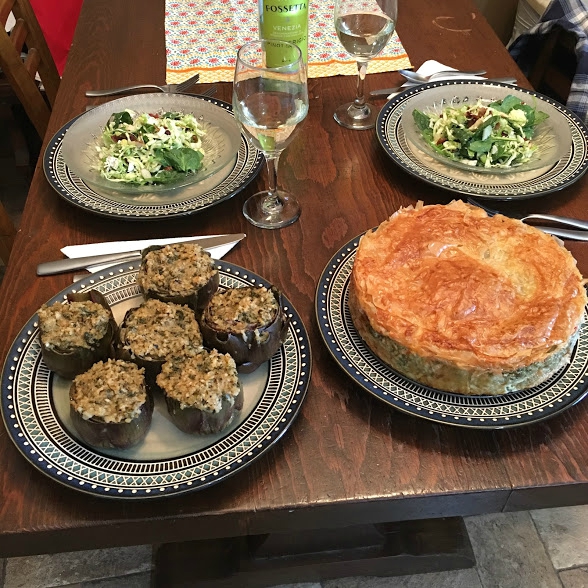


 Considering the magnitude of our last culinary endeavor (see
  We opted for two meats, chicken and steak, but prepared each differently. For the steak, as well as the peppers and onions, we prepared a variation of
  During those times when the weather is not conducive to recreational motorcycling, my friend Ann and I will sometimes get together and cook things instead. Even in the dead of winter, our kitchen antics have never caused pneumonia or frostbite. Besides, we always have fun cooking together, even on those rare occasions when we set off the smoke alarm. The dishes we prepare are seldom complicated, but we do try to keep things interesting.

 We had begun this cooking endeavor with a simple tray of rice crackers, wasabi peas and such. We ended it with fortune cookies. Oddly enough, Ann and I drew the same fortune. I no longer recall what it said, but the sheer coincidence had rendered our entire bag of fortune cookies suspect. We pressed Ann’s son, Andy, into service. She offered him a cookie. He left it there, unopened. We stared at the unopened morsel as the tension increased. When we could stand it no longer, Ann snatched up the cookie and crushed it between her fingers. I think I stopped breathing while her eyes scanned the strip of paper within for a brief eternity. At last she spoke.


 This Is MGD Time