A Quick Visit in Paradise

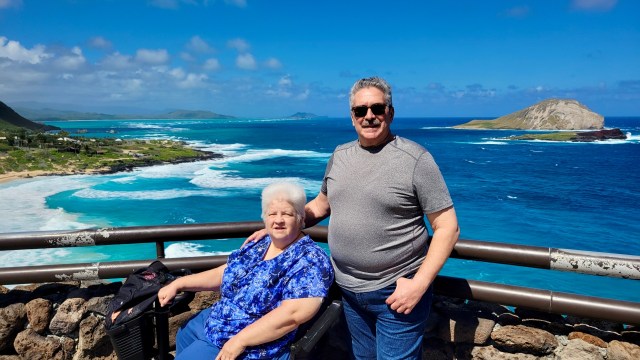
The author and his wife at Makapuʻu Lookout on Oahu.

It was a trip we could not afford to take, to attend an event I was not willing to miss. In short our son, who’s been living in Honolulu for three years, was appearing in his first professional opera, in a principal role to boot, and we had never been to Hawaii because of this or that financial issue. Well, no excuse was going to keep me at home this time.

But wait. People don’t travel to Hawaii to see an opera.

Oh, no? These people do. Walk with me, dear reader.
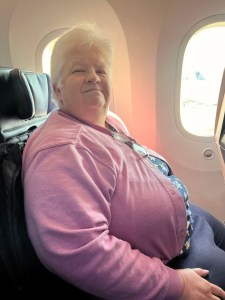
Photo of the author's wife, seated in an airplane.

It was a cold February morning when our son-in-law, a remarkable gentleman with a heart of gold, dropped Karen and me off at Chicago’s O’Hare Terminal 1, where we quickly checked our bags, secured wheelchair service for my wife, and proceeded on a long walk through the TSA security checkpoint and on to our gate. In no time at all, we were aboard a Boeing 787-10 Dreamliner and, after the our three hundred and some fellow passengers found their way to their seats, we were ready for a nine-hour sprint to the island of Oahu.

Despite flying economy, where we paid a small fortune to acquire three adjacent seats, each measuring 17.3″ wide and having 3″ of recline ability (per specs provided by United Airlines), our flight was reasonably comfortable. The windows didn’t have those pull-down shades. Instead they darkened electronically with the touch of a button. Less than an hour into the flight, they fed us breakfast. Six or seven hours later, we had a tiny salty/savory snack and a can of pop. The cabin temperature was above freezing, but I can’t say by how much. Fortunately, blankets were provided. Each one weighed a few ounces and was slightly wider than our seats.

Do I enjoy flying? No, not especially. Those who follow MGD Time know that I love taking road trips. Unfortunately, one cannot drive to Hawaii. But I digress.
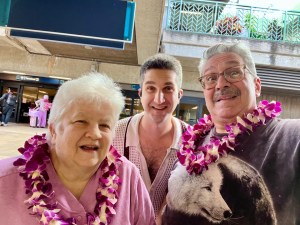
The author with his wife, and son, shortly after landing in Honolulu.

In no time at all, give or take nine hours, we were in Honolulu. And after what seemed like an extraordinarily long walk from our arrival gate to the baggage claim, we grabbed our bags and proceeded outside to get picked up by our son. When John arrived, he ran over to hug us and drape leis over our heads. Then we quickly loaded up the car and headed into the city.

Let me say this about the city. Like nearly every other city of consequential size, Honolulu has some really nice parts and some not so nice parts. Parts of Waikiki reminded me of Chicago’s Magnificent Mile with it’s upscale shops, restaurants, hotels, and more. But just like our cities on the mainland, one needn’t go very far from the best places to find the homeless, the uncared for mentally ill, and questionable looking storefronts that may or may not still be in business, and at which travelers wouldn’t likely stop to find out.

What’s different about this city is that it’s on a tropical island in the middle of the Pacific Ocean. As a result, the beautiful parts are that much more beautiful. The sad parts are that much more sad. And as my son pointed out to me, those who have hit bottom in life can’t exactly thumb a ride and go elsewhere. They have in effect become prisoners of the island.
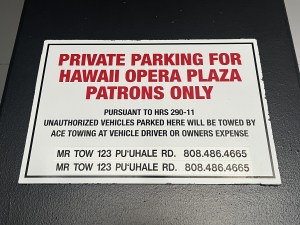
Sign inside a parking garage that begins, "PRIVATE PARKING FOR HAWAII OPERA PLAZA PATRONS ONLY"

Unfortunately, son number one’s opera was opening that evening, and his call time was fast approaching, so he needed to hand us off to his future mother-in-law Kim, who was also in town to see John perform in his first opera. So once in the city, we pulled into the Hawaii Opera Theater company’s parking garage to switch cars. It’s a relatively small parking lot underneath a building, but I felt important because, as a posted sign announced, we were in a private parking area and nobody was asking why we were there. In fact a few people even waved and said hi to our son, the professional opera singer.
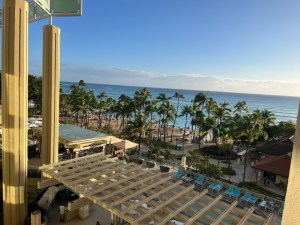
View of the Pacific Ocean from the author's hotel room

In due time, we were being dropped off at our hotel, the Hyatt Regency Waikiki Beach Resort and Spa, a twin-tower resort and convention complex complete with its own shopping mall, spa, tour services, restaurants, coffee shops, and more, so much more that they charge a daily resort fee to cover all of the “free” stuff you get by staying there — whether you use any of it or not. And before you say a word, I didn’t pick this place; that was our son’s doing. He knows a guy. What can I tell you.

Down at street level, space is at a premium and the undersized drop-off/pick-up/valet horseshoe drive is vicious busy most of the time. But once you step on the property, you’re on vacation and made to feel that way. By our son’s prior arrangement, we were given an accessible room with a view of the ocean from our balcony. A lifelong fan of waterfronts, I could have stood out there for hours, but my stomach and my wife reminded me that we needed to eat before it got much later.

The author standing poolside with an admirable view of Waikiki Beach.

As we were both too tired to strike out on our own, we opted to dine at one of the less fancy restaurants on the premises, a poolside establishment on the third floor that opened onto outdoor seating, the pool, and yet another view of the ocean, which I wasted no time taking in once we had ordered our meal and drinks.

I tend to avoid eating at hotel restaurants unless I’m there on business and have little or no choice. They tend to be overpriced, especially the bar. Now put the hotel in Hawaii, where most things costs more anyway, and then put it in Waikiki, where everything tends to be more expensive, even for Hawaii. I had a cheeseburger and fries (cue up Jimmy Buffet if you must) while Karen had the tempura fish and chips with a side of pineapple coleslaw that was actually quite tasty. She had a coke; I had two pints of a local beer. We walked out $80 lighter. Welcome to Hawaii.

The following morning I was up and out on our balcony, watching not only the swaying palm trees and ocean, but a fair number of surfers who were out hoping to catch a wave. Our first full day on island was an absolute hoot: the Aloha Stadium Swap Meet, a giant open air marketplace in the shadows of a large sports stadium that is no longer in use. Here one can find all manner of authentic Hawaiian souvenirs, crafts, foods, and more, all at prices that are below what what they charge at the tourist traps. Two bucks to get in (one for locals), free parking, and lots to see, but do wear sunscreen.

This happened to be Karen’s birthday and John wanted to make it special in his own way. After picking up some groceries and wine, we went back to the kids’ home in Manoa Valley, where our son prepared his version of stuffed peppers, a favorite of Karen’s, and along with some dear friends of John and Emma, Kim, Karen, and I spent the evening eating, drinking, and sharing many stories. Not very touristy, right? That’s exactly how Karen wanted to spend her birthday. It was awesome!

Karen and I had Sunday morning to ourselves and made the most of it by hanging out at our hotel and relaxing until it was time to get ready for our son’s matinee performance. Even though I’d like to convince you that I live for mornings like this, the truth is that it had been years since I spent a vacation morning doing nothing. Alas, my vacation schedules tend to take on some of the same characteristics of my work schedules, i.e. neither restful nor relaxing. But yeah, this was a nice way to just be somewhere, if only for a few hours.

A year or two ago, someone from the Hawai’i Opera Theatre, Hawaii’s premiere and oldest opera company, invited our son John to participate in their master class and he accepted. In short order, he began working for the company via some minor productions as well as their educational programs at area schools, both on Oahu and on Hawaii, aka Big Island. Last April, he was approached for a principal role in The Riot Grrrl on Mars, an English adaptation of Rossini’s Italian Girl in Algiers, one of HOT’s mainstage productions. After determining that this was not a practical joke, John accepted, a contract was executed, and eleven months later, Karen and I were in Hawaii to see our son, the opera singer.

We arrived at the Neil S. Blaisdell Concert Hall an hour early in order to hear a scheduled talk about the opera given by the musicologist Elina Hamilton out on the lanai. Neither Karen nor I had ever attended an opera, and I’m pretty sure this was the first time either of us had ever gone to hear a musicologist talking about one. Regardless, Dr. Hamilton turned out to be a delightful speaker and we were getting quite excited about the show.

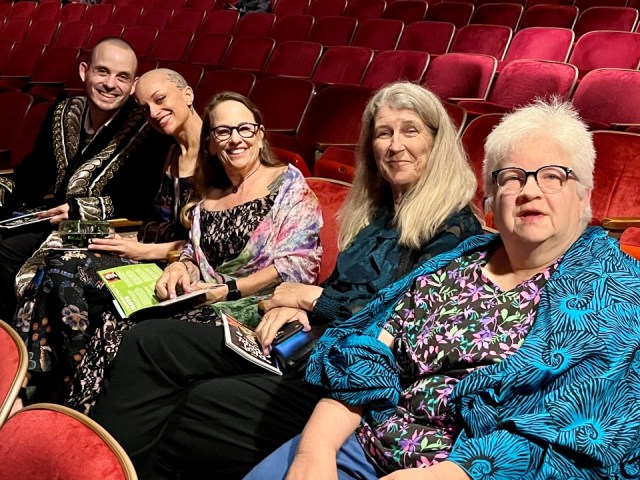
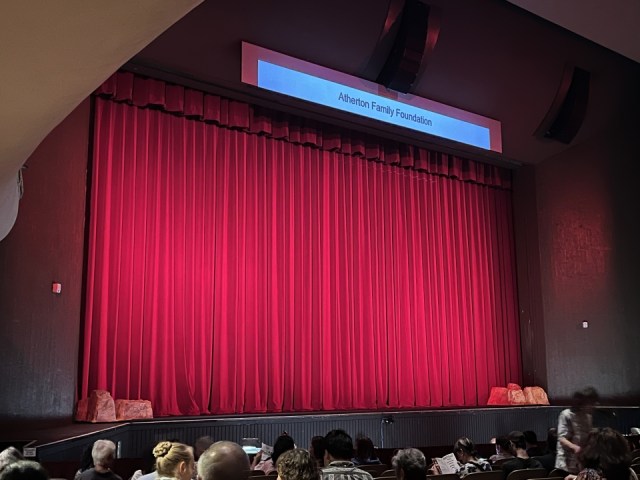
The concert hall is of modern design and well thought out, with an unobstructed view from every seat. Although the opera is in English, I was thankful that the performance featured supertitles above the stage so that folks like me could follow along. The only drawback to supertitles is that they appear above the entire stage space, nowhere near the performers, so I sometimes found my head rapidly and relentlessly bobbing up and down as I tried to follow both simultaneously.

The opera itself was hilarious. Our son, who played Gnip, the captain of the Martian Guard, appeared confident and comfortable in his role. The brief YouTube video that I am including here is the only available clip that I know of from the live performance. For his proud parents, it was over far too soon, yet I remain glad that we had been there.
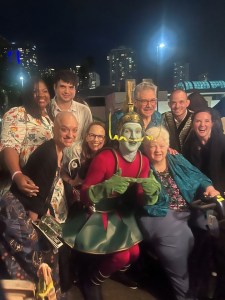
John D'Aversa as Gnip, surrounded by family and friends.

We waited outside to see John briefly before he and his fiancée headed off to an after-event involving supporters of the opera company. Karen and I went back to our hotel and as it had been pouring rain all evening, ended up back at the same restaurant before turning in for the night.

The few days that followed were devoted to spending time with John, Emma, and their friends, as well as with Emma’s mom. We went places and saw things, but not so much as tourists than as visitors. John and I even found time to slip away one evening to enjoy a few glasses of wine and some privileged father-and-son discussion time. That may not sound like much, but it’s one of the things I miss most about not having my son closer. This was our first in two years.
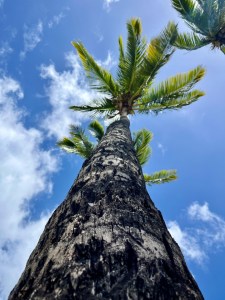
View of a tall palm tree from its base

John took great pleasure in showing us around the island, to places outside of the city, where the natural beauty of Oahu could be experienced firsthand. Every so often we would stop somewhere to get out and look around. Yes, I spent plenty of time appreciating the ocean, but I was also quite enchanted by the abundant tropical flora. In the Midwest, we have four distinct seasons, sometimes all in the same week. In the Hawaiian Islands, they have two, wet season and dry season. We were there during wet season, but only one of our days could actually be described as rainy. On the other days, every so often, it would rain for a few seconds and then stop. Most of the time, it was sunny.

I remember one such time that I found most extraordinary. We had stopped at one of many beach parks around the island and John and I had wandered off to look around and chat. At one point, we sat down on a concrete bench with the beach to one side of us and a large Banyan tree across in the distance. The sun shone brightly as we surveyed the view. Then it started raining, not hard but not a drizzle, either. We looked up to see not a cloud in the sky above. The only possible culprit was miles away in the distance, and we could only assume that the wind had carried airborne rain from that cloud across the island to drop on us. This is not uncommon. It’s also why there are so many rainbows in Hawaii.
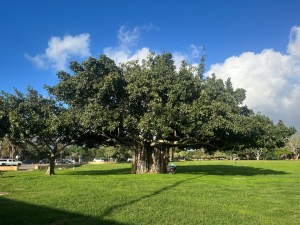
Banyan tree

I found the Banyan Trees particularly captivating. They are plentiful on the islands, although not a native species. Also known as strangler figs, what begins as one tree eventually looks like an ever-expanding cluster of them. As I understand it, the branches drop aerial prop roots that in turn develop into woody trunks.

During one of our excursions, John showed us a huge Banyan tree with an open space in the center, presumably where the host tree once stood. I strolled into the open center and turned about, looking in awe at the many tall trunks that surrounded me. Had I been there on my own, with copious amounts of time to spare, I’d have remained in that space for a little while, just to breathe and appreciate the stillness within. I rather enjoy meditating with trees.

Main building, Bernice Pauahi Bishop Museum.

Karen and I had been looking forward to visiting the Bernice Pauahi Bishop Museum, aka Hawaii Museum of Natural & Cultural History, because John had worked there for a period of time and told us much about this institution. Named for Princess Bernice Pauahi Bishop, the last legal heir of the Kamehameha Dynasty, this is the largest museum in the state and houses the world’s largest collection of Polynesian artifacts. If you want to gain a better understanding of the original Hawaiian people, their history and culture — and how much of that culture nearly disappeared and why — this is the place to go.

I was astounded as well as saddened by much of what I learned, but I was also heartened by the activist revival of Hawaiian language and culture, which continues to this day. While touring the museum, we got to meet several of John’s former coworkers and learn about what each of them does for the museum.

While walking around at the museum, our son pointed out several exhibits that he had built. Until I saw these, it had never occurred to me that our son is capable of building fine furniture, yet chooses not to do so. He has his passions and follows those. I only wish I could have been more like him when I was younger and truly pursued my interests instead of merely dabbling in them.

Taro Hut food truck

I have to tell you about this place we stopped at while John was taking us around the island. We had been meandering up toward the North Shore of Oahu and wanted to stop somewhere for lunch. After doing some quick research, John drove a little farther and pulled into what might best be described as a food truck court on the Kamehameha Highway in Kahuku, and went directly to Taro Hut, a one-of-a-kind experience featuring, among other things, amazing smash burgers served on purple taro buns along with taro fries.

Taro is a tropical root vegetable and a staple food of the islands. This is what poi is made of. All I can say is that the purple taro buns were delightfully light as well as tasty. taro fries are less greasy than their potato counterpart. They are very crunchy outside and tender inside. The flavor is hard to pin down, definitely not a potato, but tasty nonetheless. Taro Hut is a true find and gets two thumbs up for me.

Inside the shrine at the USS Arizona Memorial

The last place we visited before preparing for our red-eye flight home was Pearl Harbor. We didn’t have much time, so we weren’t able to do a full tour. We were, however, able to board a boat to the USS Arizona Memorial. This was for me a somber, sobering experience. It’s one thing to watch videos or read about Pearl Harbor, or to hear someone else talking about it. It’s another thing entirely to be there, to stand there over the wreckage and the remains. The only way I can describe it is to say that I felt the presence of those who lay below.

I have never served in the military but I have a great deal of respect for those who have. It has long been my nature to celebrate life and mourn for the loss of life “before one’s time.” Thus it was impossible for me to visit Pearl Harbor and not be moved by the experience.

Then it was over. In what seemed like no time at all, Karen and I were back at Daniel K. Inouye International Airport, making our way through the USDA and TSA checkpoints before journeying clear across the facility to our departure gate. We spent the night flying back to Chicago. I don’t think either of us slept very much during the flight, but we did doze now and then.

It was a trip we could not afford to take, but I’m damned glad we took it. We got to see our son and future daughter-in-law for the first time in well over a year and witness John’s entry into professional opera. Karen and I had finally made it to Hawaii, maybe for the only time, but who knows. I had taken my first trip off the North American continent. And we had gotten a taste, albeit a brief one, of a Polynesian paradise.

I don’t know whether this is unusual or not, but I never found myself wishing I could stay and live in Hawaii. Oahu is a beautiful place, especially away from the city. The ocean views and plant life are both awe-inspiring to me. And not once during our trip did I complain about the temperature. But I always felt my role to be that of a visitor, that I was there to experience and appreciate this island in the middle of the Pacific Ocean and then go home.

As always, thanks for hanging with me. For whatever it’s worth, it’s windy, cold, and snowing outside my window as I finish writing this for you, but it sure feels great to be home!
Like Hearing the Sound of Your Own Voice

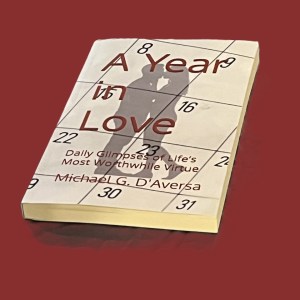
Well that was awkward. I recently experienced an impromptu live reading from my poetry collection, A Year in Love: Daily Glimpses of Life’s Most Worthwhile Virtue. Even though I was not the reader, hearing my words read aloud to a group of strangers felt a bit weird at first, but it wasn’t all bad.

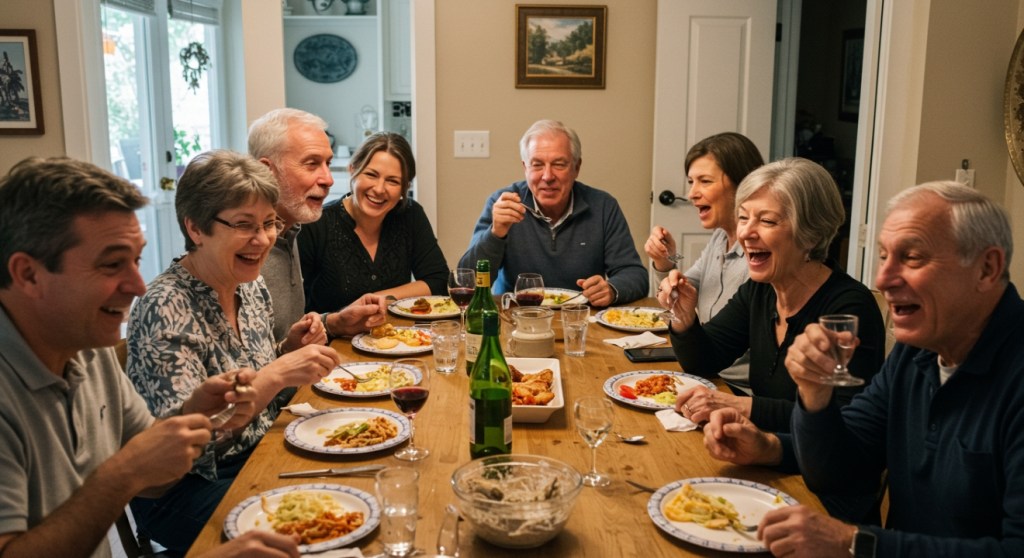
A good friend of mine periodically throws Sunday afternoon dinner parties at his home for no reason other than to celebrate food and fellowship among his friends and family. These gatherings are wonderful, almost therapeutic. Invitees often bring beverages, salads, side dishes, and desserts to share with everyone and the thirty or forty people who show up for these gatherings generally leave stuffed but happy. I seldom know more than a few people there, but that never seems to matter. There is always much laughter, no arguments started, no judgments passed, and everyone pretty much just wants to enjoy one another’s company.

And so it was on this cold Sunday in February when my wife Karen and I found ourselves seated around our friend Frank’s dining room table with a number of people, all but one of whom we had never met before, eating copious amounts of fantastic homemade food and talking about everything under the sun. After everyone had eaten and had settled into socializing, an attractive, dark haired stranger came into from another room and sat with me just long enough to extract the details behind the spinach mandarin salad I had brought. It’s a sought-after recipe that a work associate introduced to me twenty years ago and I was only too happy to pass it on to her.

Moments later, our host stepped in to see how everyone was doing, held up his copy of my book for everyone to see, talked it up for a quick minute, and then pointed to me adding, “…and this is the author; you should talk to him about it!” With that, Frank tossed the book onto the table and went off to visit several other tables that had been strategically set up throughout the first floor of his home to accommodate everybody. A flurry of questions ensued as people began passing my book around the table. What had I written? How did I write it? Why did I write it? I did my best to satisfy their curiosity.

An older gentleman, who had been sitting at one end of the table, began leafing through the book as our Q&A session continued. During a brief lull in the conversation, he held up one finger for attention and asked, “Michael, would it be alright if I read one of your poems to everyone?” Nobody had ever asked me this before.

“Of course,” I replied, having thought of no reason to object. And with that, the gentleman read his selection.

“May 28,” he began. I should point out that all but one of the poems have no titles, but are simply marked with a day of the year. “Sometimes I gently trace the contours of your lips with one finger,” he began. The entire table had fallen silent, hanging on every word. I tensed up when he got to the part about “…memorizing every aspect of your delightful mouth…” and prayed silently that no one would laugh out loud at my words. But when the reading had concluded, nobody was laughing. There was just this stillness, as if the words were still landing after having been read aloud.

I glanced over at my dear reader as he looked up from the book, drew a prolonged breath, and then exhaled slowly with lips pursed and eyebrows arched skyward, as if he had just set down something heavy. One of the ladies fanned herself as another uttered one word, “Wow.”

“That bad, eh?” I offered.

“No!”

“Not at all!” The responses came in a flurry.

“There’s just… no mistaking the feeling behind it.” I took that as a compliment as the conversation rolled along. A delightful lady who had joined our table just prior to our spontaneous poetry reading shared with me her own writing aspirations. I think the book idea she’s working on would be a hoot to read and I hope she sees it through to fruition.

An hour or so later, as my wife and I were preparing to depart, I went looking for our host, to bid him goodbye and thank him for his hospitality. “Hey, Frank,” I called out upon finding him, “you should have seen it. This one guy started reading my book out loud and…”

Frank stopped me in midstream. “I saw the whole thing,” he said with a knowing grin. “I was watching you guys from the hallway.” I guess it’s not easy to scoop my friend, especially in his own house.

I love gatherings like this because they remind me of the extended family gatherings of my youth. The attention that my book and I got, thanks to my friend, was merely icing on the cake, but the love, warmth, and camaraderie — to say nothing of all that fabulous food and drink — that was the cake!

As always, thanks for hanging with me.

Sort of Like Having a Baby

The whole thing began as a game. From 2018 through 2020, I had been amusing myself by creating motivational posts across several social media platforms, just to see if I could keep it going. By the end of 2020, though, that game had gotten old. I enjoyed the mental stimulation that the creative exercise provides, but ironically, I discovered that I had been losing my motivation to write motivational blurbs. After all, there are only so many ways to convey the same principles. At some point, a person either gets it or they don’t. But I had no desire to stop creating. All I needed was a new challenge.

My final choice came down to bad jokes or love poems and I chose the latter because I wasn’t sure whether I could come up with an original bad joke a day for a year. Love, on the other hand, has always been a favorite subject of mine and even though I didn’t fancy myself a poet, I was pretty sure I could deliver amorous free verse (short prose) poetry on a daily basis. And that’s exactly what I did. Every day from New Year’s Day through New Year’s Eve of 2021, I posted a different free verse love poem, never more than I could fit onto a square Instagram image. Nobody was ever going to equate me with William Shakespeare, but some of my followers enjoyed the ride and I had fun in the process.

While not every detail I wrote was autobiographical, the feelings behind them were genuine. Admittedly, that took some doing. Night after night, I reached back into every loving relationship I’d ever had and harvested all the positive physical and emotional sensations I could. Fortunately, I have a strong sense of recall so going back forty years or more wasn’t as difficult as one might think. And I only took the positive parts and none of the heartbreak, anger, or frustration.

About halfway through, I began to entertain thoughts of binding the poems into a book, after they had all been written, and self-publishing my year-long collection of romantic bits. And why not, I reasoned, it should be easy once all the poems had been written. Looking back now, I want to shout at that guy, “Oh, you foolish man, you!” I had grossly underestimated the task at hand. By a lot.

Seriously, I thought I’d have the darned book out within a year. When it became obvious that wasn’t going to happen, I made arrangements to steal away to a hotel up in Wisconsin for a few days to assess the job at hand and begin giving my proposed book some structure (see My Self-Imposed Seclusion). This was where I realized just what I had gotten myself into. First off, not all of my material was suitable for publication. It’s one thing to fire off a few lines of affection and post them on social media, but it’s a whole ‘nother thing to arrange them into a book that people want to pay for. And the key word is arrange. Besides the edits, rewrites, and outright replacements that surely lay ahead. None of these poems — 365 of them — had been released in any kind of logical order. Holy cow! Well, at least I’d had the foresight to bring some good wine along.

Imagine looking at 365 randomly written poems that had to be sorted out somehow. They had a common theme, but there had been no clear flow between them, no story to be told. None of them even had titles. I began looking at them individually, not with the intent of editing but just to see if I could at least place them into buckets.

“That’s it, buckets!” I exclaimed aloud, startling myself, to say nothing of whoever may have been in the neighboring rooms at the time. But I had no time to lose. I went back to the beginning of the pile and began placing each raw, unedited poem into one of four imaginary buckets, each representing a three-month quarter. The first quarter represented beginnings: meeting someone, being attracted to someone, becoming smitten with someone, you know, the early stages of love, in whatever form it might take. The second quarter dealt more with earthy, physical affection. Advancement, if you will, but still at a gut level. The third bucket was for the poems that attempted to see past mere physical affection. And the last bunch were the ones reaching for fruition, for something more permanent than the earlier pieces.

Lacking titles, I assigned each poem to a day of the year. Everything was still tentative at this point, but at last I had a loose sense of logic regarding how these poems would be presented in book form. I even added a placeholder for a 366th poem, not yet written, that would be devoted to February 29, the Leap Day.

Three days later, I thought I knew what I was doing. I left my Wisconsin hideaway with a logical structure for the book and one month out of the twelve drafted. As it turns out, I would still be making adjustments to my plan for two more years. That’s a very important strategic principle, by the way. When things don’t go the way you thought they would, as long as you’re sure of the goal you set, you make changes to the plan, not the goal.

From the beginning, my intent had been to self-publish this book, mainly because so many of the poems, or raw versions of them, had been placed in public view on social media platforms. Self-publishing gives the author a lot of control over all aspects of the book, but with that control comes responsibility — and quite a bit of work. The final manuscript had to be delivered as a 100% print-ready file meeting a lengthy list of technical, artistic, and legal requirements, enough to make a newcomer’s head spin. And every little change, whether to the content, the layout, or even from one file type to another, was an opportunity for something else to go wrong.

The first full draft of the book, including all the front and back matter, was completed sometime during the second half of 2024. Knowing I am my own worst proofreader, I asked my wife, who had worked as a public relations writer and editor in a past life, to have at my manuscript and give me her suggested edits. This she did no fewer than five times, including the proof copy, finding things that had passed before my eyes unnoticed. Besides the usual typos and grammatical glitches, Karen drew my attention to passages that despite being correct as written, I was able to make better. This is what a good editor does.

The most stressful part, for me, was the actual publishing. Despite having launched a half-dozen corporate websites, developed and contributed to various blogs, and even executed a few million-dollar direct-marketing campaigns during my professional career, I was as nervous as a kid on his first date putting out this little poetry book. There were so many choices to be made and questions to be answered, each a good bit of research. Then came the cover art, the marketing plan, and so forth. By the time I got to it, making the final click that would set everything in motion, was like pulling the trigger on a 10-gauge shotgun.

And then it’s over. A Year in Love: Daily Glimpses of Life’s Most Worthwhile Virtue, available in paperback and ebook editions, was officially published on December 17, 2024. The copyright registration process, a task in itself, is underway, as are some basic marketing activities, but the book is done. It feels so good to say, “I did it,” but there is also a letdown from realizing that the job is finished. Almost 30 years ago, when I finished my first full-color product catalog project, I told the head of the agency that had handled the project that I was both glad and sorry to be done with it. “Yeah,” she replied, “it’s kind of like the postpartum period.” Being a guy, I can’t know firsthand what giving birth is like, but my sense of things is that she was correct.

As always, thanks for hanging with me.

When Life Attacks

People often use the phrase “life happens” as a sort of catch-all explanation for why things don’t go as planned. The implication is that life continually happens to us, the passive, unwitting masses. The actor Jim Carey has suggested that life actually happens for us. What I want to know is what do you do when life repeatedly and relentlessly attacks you from all sides? Huh? What do you do?

This story begins in late October, when my 95-year-old mother-in-law suffered what appears to have been a mini-stroke caused by multiple occlusions, which had until then gone undetected. Her son, a retired healthcare worker with whom she lives, rushed her to a local hospital ER, where she was diagnosed and admitted for treatment. Sometime after that, Mom was transferred to a rehab center for physical and occupational therapy.

A few weeks later, my brother-in-law and his wife were scheduled to be at a family wedding in North Carolina. The wedding was to take place on the same day as my daughter’s “big second wedding reception,” but I’ll get to that later. Our intent had been (a) for my wife to care for her mom in her brother’s absence, (b) to involve Mom in our daughter’s big celebration, and (c) to give Mom a nice Thanksgiving. In one fell swoop, all of this had become uncertain at best.

In the days that followed, after one of several visits with her mother at the rehab up in Lindenhurst, my dear wife suffered an unfortunate accident while getting into her car in a near-empty parking lot after dark. The result was an awkward fall that resulted in multiple fractures to her left leg and foot. She texted me from the emergency room of a hospital in Libertyville, “Please don’t get mad,” and proceeded to tell me what had happened. Our son, who lives in Rogers Park on the far north side of Chicago, miles closer than my own home, drove up to offer assistance. The medical staff at the hospital in question — and there seems to be a great deal to question — saw fit to splint my wife’s leg, told her not to put any weight on it, and promptly discharged her. Eventually, our son drove her home.

Meanwhile back in Plainfield, while our son was driving his mother home, our daughter, with the help of her husband and a friend, set up a corner of our TV room with a mini fridge, commode, food, beverages, and other accouterments, with the hope that my injured wife would be able to make do without risk of injuring herself further. In no time at all, it became clear that this was not to be the case. The following day, we were all working together to seek more competent medical attention for my wife.

I should mention that while all this is going on, I had arranged to work remotely in order to ensure that Karen would never be left alone in such a vulnerable state. I can only thank God and my employer, a family-oriented company not quite like any other I have experienced, that this was even possible. Even so, life just kept right on happening. I had been working away on an almost calm Thursday afternoon when the news came to me via email that my mentor of the past four years, also my direct superior, partner in crime, and friend, had “parted ways” with our company. This seemed odd to me, as only hours earlier I had neither seen nor heard any indication from the man that he had any intention of executing such a departure anytime soon. Hmmm. As is my nature, I reached out to people. No information was volunteered and I did not pry. I just let it go at that and went back to shouldering life as it continued happening. And believe me, you ain’t seen nothing yet.

A day later, a competent orthopedic surgeon examined my wife’s injuries, gave a rather alarming assessment of the “cookie cutter splint” that had been applied at the previous facility, scheduled urgent weekend surgery two days hence, and having declared that my wife should never have been discharged in her vulnerable condition, sent her to the emergency room across the street from his office.

Sometime after 3:00 AM the following morning, Karen was admitted to Silver Cross Hospital. One day later, on a Saturday morning down in surgery prep, we were informed that due to a testing oversight, surgery would have to be postponed. To say that Karen was displeased doesn’t quite cut it. Because she could not be safely discharged, my dear wife was now stuck in the hospital pending that surgery. Meanwhile, our daughter’s second wedding reception, two years in the making, was scheduled to take place that very evening.

You see, it’s like this. Two years ago, in the midst of the COVID-19 pandemic, our daughter got married. Teresa had always wanted a big feast of a wedding, like Karen and I had enjoyed so many years ago, but the pandemic restrictions rendered that impossible. At one point, Teresa and her husband-to-be had created a spectrum of contingency plans, ranging from a restricted ceremony with the two of them, a priest, and a witness at the low end, to a modest celebration of up to maybe 50 people at the high end. The latter is what took place, but the whole time, they vowed to follow up with a full-blown reception the following year, after all the restrictions had been lifted. Unfortunately, the following year still held some restrictions and much uncertainty. And so it came to pass that 2022 would be the year of the big second reception.

Karen had been in tears when she realized that she would not be attending our daughter’s big reception but nobody was willing to place her in harm’s way for the sake of attending a party. Still, we all vowed to do the next best thing. If we couldn’t bring Karen to the celebration, we would bring the celebration to Karen! All night long, an entire team was busy capturing elements of the celebration and streaming them to my wife. And believe me, it was a hell of a time. Being surrounded by friends and family enabled me to set aside all my concerns of the day, if only for the moment.

The following Tuesday, we were back in line for surgery, only this time it happened. Without going into the sordid details, the surgery ended up being every bit as involved as it had promised to be, involving substantial hardware to compensate for one repair that would not be possible. Still, it had gone smoothly, the surgeon assured me. As expected, there would be a lengthy recovery ahead.

Hours had passed before I was able to see Karen again. When they brought her back to her room, my wife looked like she had seen too many miles of bad road. I opted to let her rest and went to run all the errands she had assigned to me prior. By the time I returned to the hospital that evening, Karen was her old self again, with color in her face, a twinkle in her eye, and that unmistakable sense of humor that we have so long shared between us. We still had no solid indication of how much longer she would be in the hospital or exactly where she would go next.

Two days later, happy Thanksgiving! Karen was still in the hospital. Administrative red tape, undoubtedly lengthened by the holiday weekend, prevented us from knowing with certainty where she would be going from there, but we knew it would not be home. Based on recommendations from the social worker and from our primary care doctor, Karen selected a rehab facility close to home. But there was paperwork to be filed and then reviewed by somebody, somewhere, before we would have any kind of confirmation of the transfer.

Long before any of this had transpired, our son John had begun scheming an “event within the event” to take place on Thanksgiving Day, which would be hosted for the first time by our daughter Teresa. John assembled an entire team of accomplices, all working together below the radar of his significant other, Emma. Even her mom was in on it, agreeing to fly in from California the night before and be snuck into the house that morning, under cover of carefully orchestrated distractions. At the appointed moment, everybody came together and witnessed a beautiful and most eloquent proposal, all live-streamed to my wife’s hospital room, of course. There were many teary eyes, my own included.

Life, which always happens, had begun to cascade. The following morning, Emma would depart Illinois, first for her home in California and shortly thereafter to Honolulu, to start her latest job assignment. John will follow her sometime in January. Between now and then he will get their belongings moved from their Chicago apartment and move back home for a few weeks, along with their dog and cat. Then he, too, will be off to Hawaii.

But wait, there’s more! I woke up the Friday after Thanksgiving with telltale sinus issues that seemed to indicate I would be coming down with a cold soon. I was already committed to making a run up to see my mother-in-law and bring her some fresh laundry that I’d done a few days earlier. Not being able to make that run on Thanksgiving had killed me inside but with everything else afoot, it was impossible, simply too much — and I was the very last to admit it.

I stopped in Rogers Park to pick up John on my way up. During my last visit to see Mom, when I had picked up her laundry, she wasn’t sure who I was. I tried to help her remember, unsuccessfully, and went home feeling so deflated and alone. My son had this knack for drawing a reaction from his grandma, even if she wasn’t sure who he was, and so he gladly came along. We did better together than I ever would have on my own. I am grateful.

By all rights, this should be the end of my story and it would have been more than enough at that. But you see, life doesn’t just happen. Life continues to happen, sometimes relentlessly.

By Saturday morning, my “cold” symptoms were much worse and on top of all else, my senses of smell and taste had completely disappeared. After more than two years of testing negative for the COVID-19 virus, I had become convinced I was a “no-vid,” incapable of becoming infected. But my God, I had just spent a day surrounded by people celebrating Thanksgiving and then gone to visit my 95-year-old dear mother-in-law, stopping from time to time to visit my health-impaired wife in the hospital! Could there possibly be a worse time to contract this damned thing?

Of course you know what happened next. Not just one but two tests came back positive and I was instructed to quarantine for five days, to inform anyone whom I might have exposed, and to inform my employer and ask once again to continue working remotely. Please pause for a moment, look back on everything I have just shared with you, and try to imagine what this task might look like.

I do think I may be the most fortunate man alive. In addition to the outpouring of sympathy and understanding from my wife, my family, and my friends came nothing but solid support from my employer of almost exactly four years and a plan for moving forward from all concerned. And this is exactly what has enabled me to continue on in the face of life as it happens.

Now I am healing. My wife, still in the hospital, waits patiently for her rehab assignment. Various family members and friends are dealing with cold, flu, and covid infections, not all of which are related yet we recognize that we are related and hold each other up as we move forward. We have only one rule and that is to never ask, “What next?”

Unlike most of my stories, this one has no clear ending. Life happens, sometimes all at once. The thing is, life will keep right on happening until it ends. Whether you believe it is happening to you or for you, what you do with this ever-unfolding life is up to you.

Me, I’m still here, still standing, still moving forward. It’s been an interesting few weeks, though. And if you’re still here with me, reading along, thanks for hanging with me.

Her Name Is Hazel — Here’s Why

I have not named every vehicle I ever owned. Not even most of them. This one, however, needed a name. That became clear to me before I had even brought her home. Until a few days prior, I hadn’t been planning to buy a car, but that all changed when the Chevy I’d been driving for the past eight years lost its power steering and in the process, unveiled a long list of items I’d been neglecting, many safety related. So I went hunting for a good used car that had at least some of the features I wanted for as close to what I could afford (namely $0) as possible.

I’d had a great experience using CarMax in the past, so I went back, first online and then in person. Last time, I’d had it down to two cars before I made my final choice. This time, there was only one. An unusual find in my price range, the car to which I kept returning as I sorted and filtered my online search was a 2014 Volkswagen Passat SEL. The model year was at the older end of my range, but the SEL’s premium trim level would otherwise have been out of my price range. Although six years old, the car had just over 51K on the odometer — chicken feed for someone who drives as much as I do. Having ridden in and driven Passat models owned by a couple of my coworkers, I had a pretty good idea what to expect. If this car seemed nearly as nice in person as it did online, she would become my next ride in short order.

Oh, she was sweet. Getting into a Passat is not unlike going down the rabbit hole. It’s not exactly a small car on the outside but it’s positively cavernous on the inside. The backseat area has more headroom and legroom than does my old Impala, and that’s not all. The seemingly puny little 1.8L four-cylinder engine doesn’t sound like much — a Facebook friend of mine in Germany quipped, “my Windscreen Wiper has got a bigger Engine” — but it’s turbocharged and would have given my old Chevy a run for her money. The view from the driver’s seat is generous, which may help explain why the car seems almost deceptive in how smoothly she comes up to speed and continues right on to speeding territory. I’ve already caught myself up over the 100 mark while grooving to my tunes on the car’s Fender premium audio system. In other words, I gotta’ be more careful.

Obviously, I did not “do the ton” (British slang for going 100 mph) while taking my test drive so yes, I came home with the car. But the question soon became: What to name her? Now you may be asking, why name her at all? And you would be right to do so. As I’ve already said, I haven’t named all of my vehicles, just the special ones. And while, ever since I crashed my beautiful red 2005 Honda ST1300 sport-touring motorcycle, I have vowed to never again become emotionally attached to a mere machine, I understood that this car was going to be special. Special enough to warrant having a proper name.

When naming a vehicle, I have always striven to capture some essence of the machine itself. The last one I named, for example, was my 2012 Victory Vision Tour, a “full dresser” motorcycle that I ride to this day, when conditions permit. The bike is metallic red with black and gray as secondary colors. I named her Miss Scarlett not because of her predominant color, which in all candor may or may not be precisely scarlet, but because of the flowing lines of her rear end, which make her side bag luggage appear roomier than they really are. That red color, combined with the sweeping shape of her outer bodywork, called to mind the hoop skirts worn by the leading female character in Gone with the Wind. I never once thought to name her anything different.

Which brings us to the issue at hand: Why on earth would I come to name a gray car Hazel? That’s a fair question. Do you have a few minutes?

For a kid who was born into a blue-collar, Italian immigrant family, I was blessed with a most enchanted childhood. One of the people who made it so was my maternal aunt Erminia, who is solely responsible for my deep-seated wanderlust as well as my sincere appreciation for ethnic, racial, and cultural diversity. Born in 1923, my Aunt Erminia was the only family member of her generation to attend college — in fact she held multiple degrees. She never married and during my formative years, she worked as a physical and occupational therapist for the East Chicago, Indiana public schools. This is why she was able to toss my sisters and me into the back of her station wagon and take us on multi-week summer road trips. As such I have seen most of the 48 contiguous states and quite a few Canadian provinces as well. But I digress.

Auntie had a number of interesting friends — good friends — one of whom was named Mrs. Gray. Like many of my aunt’s friends, Mrs. Gray had been a school teacher, but she had also done many other remarkable things in life. A woman of color, Mrs. Gray had also been a civil rights activist and, according to stories told to me by my aunt, had gone to jail standing up for what she believed in. I only knew her as a very kind lady with a very nice family, a family with whom my family had gone on camping trips and other outings. And back then, in my single-digit years, I only knew her as Mrs. Gray.

Well, nobody would see anything clever about naming a gray automobile Mrs. Gray, so I set about asking my eldest sister abut her first name — because quite frankly, after more than 50 years, I wasn’t so sure about that detail. It was my eldest sister, the retired librarian with an awesome memory, who immediately filled me in. “Yes, I do remember Auntie’s friend, Hazel Gray… I have fond memories of her and her family, going on camping trips with Auntie and the Grays.”

Hazel! Yes, I remembered her being called Hazel by the grownups. I also remembered she had a daughter named Elmyra and two sons, Oscar and Arthur, the latter of which had died quite young, the victim of a rip current while swimming in Lake Michigan (it’s sometimes amazing what my mind retains). The only thing my sometimes OCD mind had to be sure about was the spelling of her name, just for my personal satisfaction. Was her name Hazel Gray or Hazel Grey? I had never seen the name in print, so I never knew. A little online research, using what I did know, produced an obituary for one Hazel Lucille Whitlock Gray, unquestionably the dear lady whom I had been seeking. I only wish I had a picture of her to share with you.

Well, this is where my explanation ends and my car’s new story begins. Her name is Hazel. It’s short for Hazel Gray and in my estimation, that’s a fine name for my automobile. I only hope this car can live up to the name I’ve chosen for her.

As always, thanks for hanging with me.

When the Pavement Ends: An Anecdote

Unpaved 1

Don’t ask me why, but I never posted anything about this back when it happened, during my last Labor Day weekend road trip. Never told the story or posted the video, not even on Facebook. In hindsight, the whole thing was rather comical. Nobody got hurt or even came close to getting hurt. It was just one of those things of which fond memories are made.

img_3932

It was the evening of Saturday, August 31. My son John and his friend Marjorie, along with my friend Ann and me, had just finished dining at the General Store Pub in Stone City, following a full day of touring east-central Iowa by motorcycle (see While I Was Away) and the time had come to head back to our hotel. I was feeling a bit tired and asked my son if he would like to lead the ride back to Cedar Rapids.

“Sure!” John replied. “Would you mind if we take a scenic route?”

“Do you have one in mind?” John studied his phone for a minute or so before pointing up the side road on which the pub was located.

“Yes! That way!” The grin on his face gave me cause for concern, as did the quiet, lonely look of that road he had pointed toward.

“Are we taking paved roads?”

“They all look like major roads.”

I looked at Ann. I looked at Marjorie. I looked at John, who was still grinning. Then I shrugged and said, “Lead the way!”

Unpaved 2

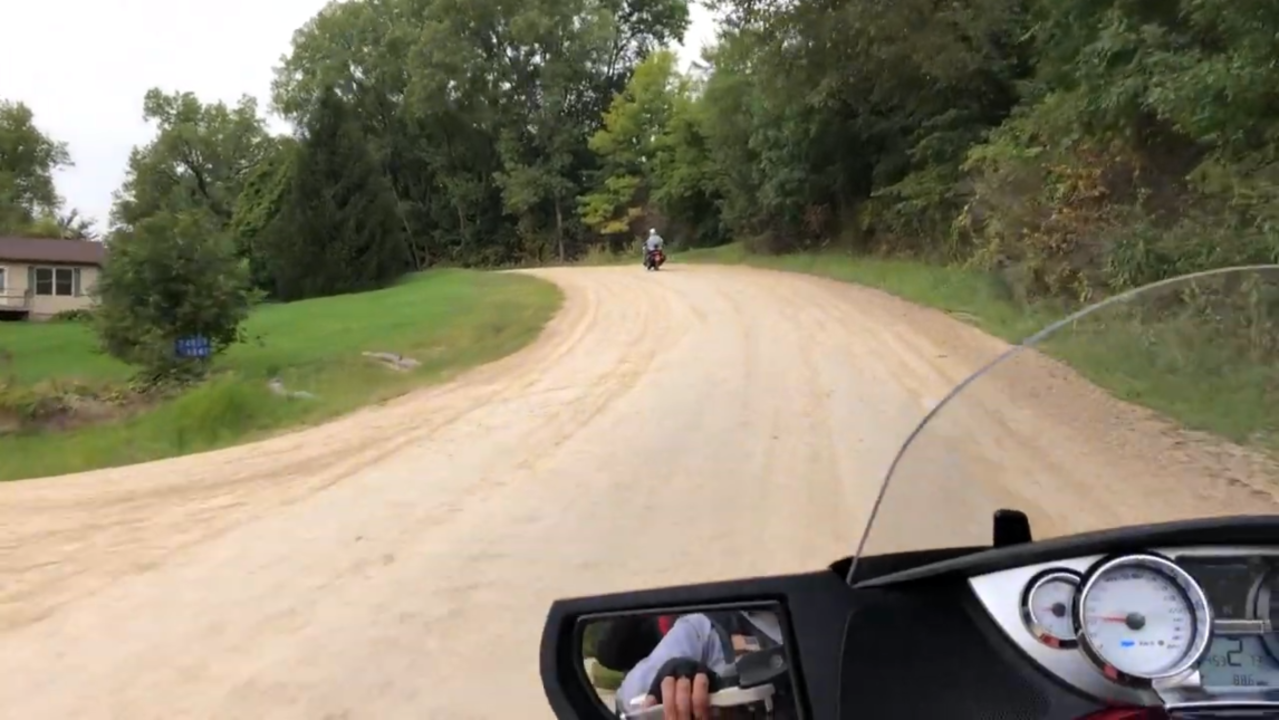
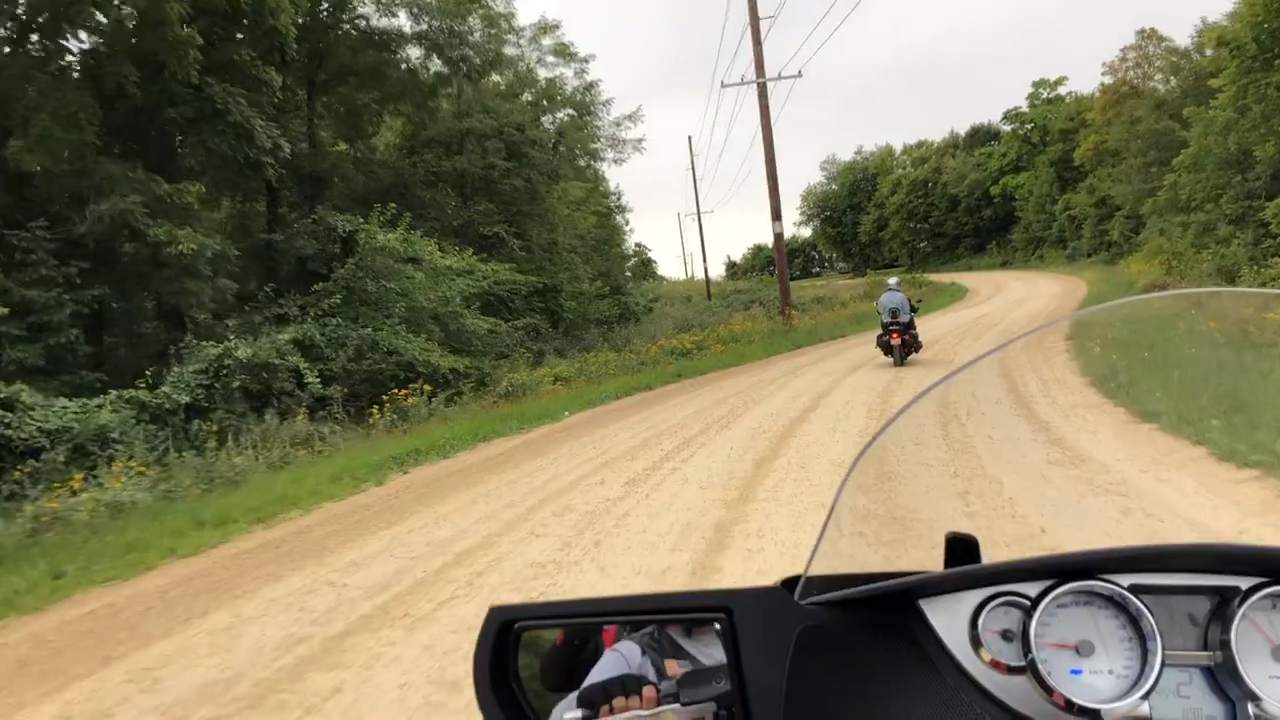
Perhaps you can guess what happened. As soon as we got out of town, the road began to rise into the hills and the pavement grew ominously thin before disappearing altogether. “Did I not ask him,” I growled into my Bluetooth headset, “are they paved roads?” Ann did her best to console me as we continued our ascent over the dirt and stone roadway but I knew from previous experiences that she was not entirely comfortable traversing gravel roads on two wheels and that in and of itself concerned me.

Unpaved 3

Then it began to rain. More of a light drizzle, actually. Miss Scarlett, my trusty full dresser touring bike, was solid as a rock the whole time but I was not pleased. If it began to rain any harder, the dirt beneath our tires would turn to mud. I spoke calmly to Ann via my headset mic, “We’re good.” She never once complained. The road went on. In all, it was probably just a few miles but we were traveling in lower gears and in my mind, the journey seemed to take forever.

Unpaved 4

“John!” I called out after my son as I shook my fist in the air, knowing full well he couldn’t hear me. The big question remained, however: How much longer would it be until we reached solid pavement again? We rolled on.

Unpaved 5

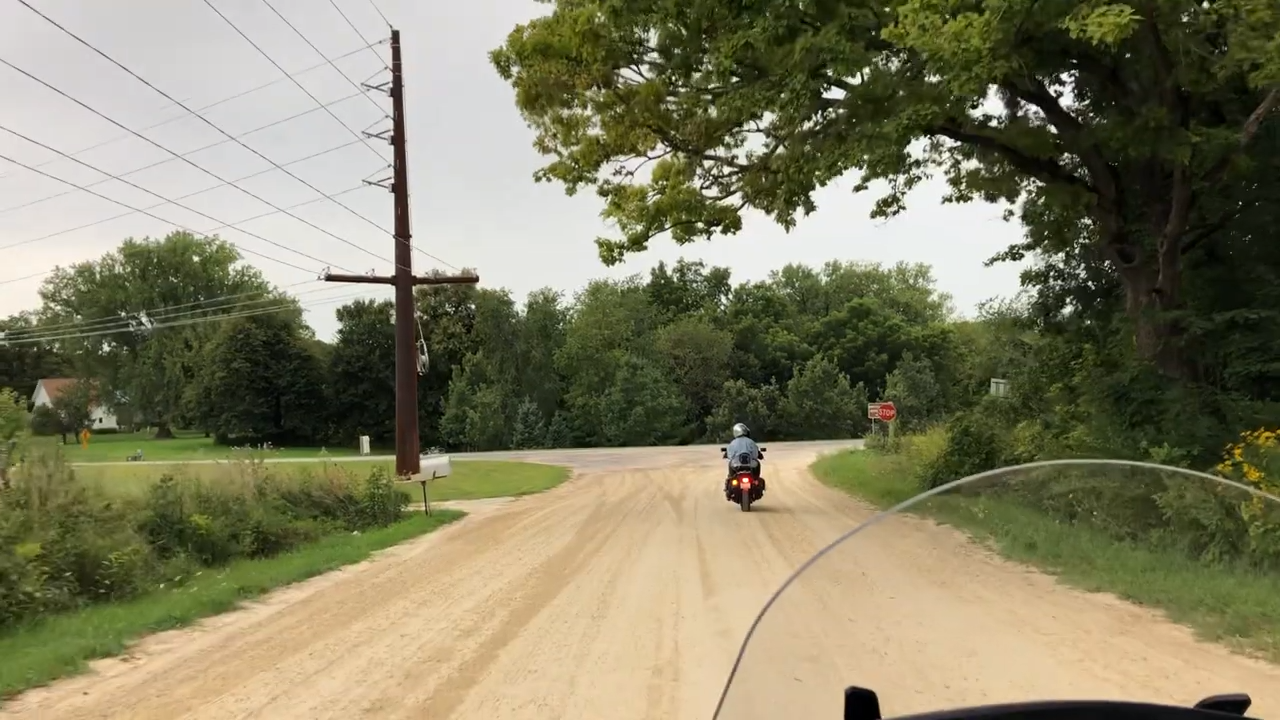
The intermittent rain that had so concerned me earlier disappeared altogether as we ascended one last hill and came upon a most welcome sight — a beautifully paved road at the termination of our dirt and gravel ribbon. John came to a full stop at the crossroads. I drew up alongside of him, laughing too hard to sound very angry.

“Paved roads?! Paved roads?! I’m gonna kill ya!” We were all laughing. I nodded to John and Marjorie. They pulled away, turning onto the precious two-lane blacktop. Ann and I pulled forward and leaned Miss Scarlett over to follow them. The remainder of our ride back was uneventful.

Here is the footage Ann shot as all of this was unfolding. As I said, this was just one of those things of which fond memories are made. Indeed, I chuckled as I wrote this little anecdote and I hope that Ann, Marjorie, and especially John will also smile and laugh when they read it.

I have often looked upon motorcycling as a metaphor for life. So what are we to do when the pavement ends? Keep on rolling. Trust in your own abilities to keep yourself and your loved ones safe. Do your best. And remember to laugh about it afterward.

Thanks for hanging with me.

My Shrinking Demographic: A Tale of Two Trade Shows

A message to the automobile manufacturers and motorcycle manufacturers of the world: I am not the man you are looking for. You know it—well, most of you do, anyway—and I know it. I came into this world toward the tail-end of a generation known as Baby Boomers. For decades, we were the only generation that mattered. We were huge! But like the Traditionalist generation before us, we’ve been dying off. Without going too deep into Generation X, the Millennials, or Generation Z—all of whom came after me—the thing of it is, my generation is no longer capable of sustaining, let alone expanding, the automobile and motorcycle industries. Mobility scooters are another story, but let’s not go there today.

I attended two consumer trade shows this month, the Chicago Auto Show and the Chicago Motorcycle Show, each considered major consumer shows in their own right. I have a longer, if less consistent, history with the auto show, but a much more recent history with the cycle show. Both have changed a great deal over the years. Let’s talk about the car show first.

This slideshow requires JavaScript.

I began attending the auto show years before I obtained my first driver’s license. I was a bona fide car nut and an aunt of mine would humor my addiction by taking me to the auto show. This was way back when McCormick Place only had one building. Never mind that I was still in grade school at the time. I could identify nearly every automobile made at the time just by looking at its front grille or rear bumper. No exaggeration! I would go from manufacturer to manufacturer, sitting in cars, collecting literature, and dreaming my dreams. Sticker prices meant nothing because money was no object to me at the ripe old age of twelve. See, I already knew what I was going to be when I grew up—I was going to be rich—so in my young mind’s eye, I could eventually have any car I wanted. And believe me, I coveted some good ones.

Today the American car buyer/leaser is interested in big honkin’ trucks and SUV’s. Smaller segments are into sporty little cars, earth-friendly vehicles, and believe it or not, economical transportation choices. Me, I grew up to become a sedan man. Most of the cars I have owned in my adult life have been sedans. My current ride is large, exceptionally comfortable ’08 Chevrolet Impala with a nicely appointed interior, for its age, and a buttery-smooth ride. Nobody buys sedans anymore, so the genre doesn’t get a lot of attention from the manufacturers, neither in R&D nor marketing. At the auto show this year, the “bigger” sedans were not too plentiful. What is available was displayed, but not exactly showcased. Hey, I understood. And on the bright side, I never had to stand in a long line to sit inside one of them.

This slideshow requires JavaScript.

So what did I look at? I glanced at the current iteration of my Chevy and walked past the Ford and Buick equivalents. Though I have never owned a foreign car—the closest thing being a 1985 Renault Alliance built in Kenosha, Wisconsin—most of my attention was captured by the Volkswagon Passat, the Subaru Legacy, and the Nissan Maxima, that last one being my current “if money were no object” choice. It just speaks to me.

So much has changed since the last time I attended the Chicago Auto Show a decade or two ago. There’s no denying it’s a smaller show. Numerous marques have gone out of existence since the last time I was there. When I was a kid, the aftermarket/accessory/travel/merchandise vendor booths took up nearly a floor of their own at what is now called the Lakeside Building at McCormick Place. That was a lot of square feet. This year they took up a small fraction of that. To be sure, the new show had some astounding features not found in 1974, such as in-show demo rides and outdoor test drives. But for me, the sheer grandeur of this show has shrunk back a bit.

Capture IMS 2019

To be sure, the Chicago stop of the International Motorcycle Shows (IMS) used to be physically larger, not because so many brands have gone out of existence since I began coming (a few have), but because fewer exhibitors are showing up.  More on that in a bit. But this has always been a very different show than it’s automobile counterpart. Motorcyclists are a smaller segment of the U.S. population at large and perhaps a bit more fragmented as well. I’ve been coming out every year since I became an active motorcyclist in 2003 (I was a late bloomer, but a fanatical one). I have seen a number of changes in the hobby, the industry behind it, and this show, which to a degree represents it.

This slideshow requires JavaScript.

To its credit, the IMS really does try to have something for everyone, but it’s really up to the exhibitors to deliver. Let me explain. I can recall a period of years during which there seemed to be a bit of one-upmanship going on between the motorcycle manufacturers on at least three different fronts. The heavyweight cruiser class was wide open and several players were vying for the largest displacement engine—separate and apart from Boss Hoss, a specialty manufacturer of motorcycles powered by Chevy V8 engines. Despite a gentlemen’s agreement among the major manufacturers to limit the top speed of their really fast bikes to 300 kilometers per hours (about 186 MPH because more than that would be unsafe), the players in the sportbike class were still vying for fastest production motorcycle, which I assume would be the one to reach 300 KPH the soonest. And on yet another front, several of the major manufacturers were trying to unseat the Honda Gold Wing as the premier touring motorcycle by which all others would be judged.

It was the best of times to attend the IMS. The accessory / aftermarket / merchandise aisles were packed, too. Then the Great Recession hit. Motorcycle dealerships were closing left and right, as were some less-than-major manufacturers and a number of aftermarket companies, too. The terrain of the motorcycle dealership and merchandising networks was forever changed, the IMS scaled back accordingly, and if you ask my opinion, the industry has never been the same since then.

This slideshow requires JavaScript.

But the show has gone on and people still attend. If anything, the crowd seems more heterogeneous than before. It may be me, but I seem to recall the “black leather and gray hair” bunch being more dominant ten to fifteen years ago. They’re still present, to be sure—I’m sort of on the fringe of that demographic myself—but they no longer dominate. I’m not sure anybody does. Which brings me to an issue similar to, but not quite the same, as I described while describing the auto show.

I’m a touring rider. I ride big-displacement bikes configured for comfort and overnight travel. These are not entry level bikes, nor are they cheap by any definition. Many people can’t afford them. In point of fact, I can’t afford them—never mind that I have owned three so far. The touring bike class has never been the dominant segment of the motorcycle industry, but it has been significant. I commented earlier that I am sort of on the fringe of the black leather biker demographic. That’s only because I currently ride an American-made, big-inch V-twin and as the result, I tend to dress more like a pirate and less like a spaceman. But only six years ago, I was riding a much faster Japanese sport-touring rig and back then, I dressed more like a spaceman. So you see, it’s all relative.

But no matter how you slice it, my demographic is in decline, along with several others. The generations that follow are for the most part decidedly not marching in line with us older types. Big-inch V-twins don’t excite the later generations. Neither do the full dresser touring rigs or their sport touring subset. Or racer replicas. Surely there will always be technical riders, sport riders, and hooligans, but these will not dominate the hobby.

This slideshow requires JavaScript.

What will? In all candor, I don’t know. But neither do most of the major manufacturers, from all outward appearances. Enter the newcomers! The ultra-affordable low displacement, high-mileage bikes. The unconventional three-wheelers. The electrics. And whatever comes next. But here is where it gets tricky. Despite the fact that motorcyclists in total are a minority of vehicle owners and operators in the US, the various segments (fragments?) of the hobby haven’t historically been too tolerant of one another. For the sake of our hobby and the industry that both supports and depends upon it, this must change. Now.

During my visit to the 2019 IMS, I had the pleasure of listening to and speaking with my friend Gina Woods of Open Roan Radio, and a newer acquaintance of mine, Robert Pandya who helped bring the Discover the Ride experience to life at IMS events across the country. I can’t say enough about either of these individuals and the contributions each has made to our hobby and to the motorcycle industry at large. And while each will eagerly acknowledge the heritage of our hobby, they are equally eager to acknowledge and welcome that which is new and exciting. We need more people like this influencing the industry.

IMG_5637

And so here I sit, figuratively speaking, upon Miss Scarlett, my 2012 Victory Vision Tour (did I mention that Robert Pandya worked for Polaris when they brought the Vision to market?), looking forward to the upcoming riding season. I may no longer be the primary demographic target for either the automobile or motorcycle industry, but I still have my eye on certain products of theirs and amusingly enough, they still have their eyes on my spending dollars. Maybe it’s a love/hate thing.

As always, thanks for hanging with me.

Romancing the Blade

Mug Brush

My fascination with shaving has a lengthy history that began when I was a small boy and became aware of this ritual performed by grown-up men. For as long as I knew him, my grandfather shaved with a safety razor, a mug of shaving soap, and a brush. He also had an old straight razor in his basement bathroom and although I never saw him use it, I’m sure he had done so once upon a time. I rarely got to watch Grandpa shave, but the few memories I have of those times involved him coming out of his bathroom with one or two fragments of tissue stuck to his face. I would later learn firsthand that this was a tried-and-true method for catching and holding blood droplets from the seemingly inevitable razor nicks and cuts.

Norelco

My dad’s arsenal was a bit more modern. He was a Norelco man, having owned numerous corded and uncorded models over the decades. But he also had several safety razors, at least one in each bathroom, and he used them on occasions when he wanted a particularly close shave. Pop professed that he could go for two days between proper wet blade shaves, whereas his electric razor required daily use.

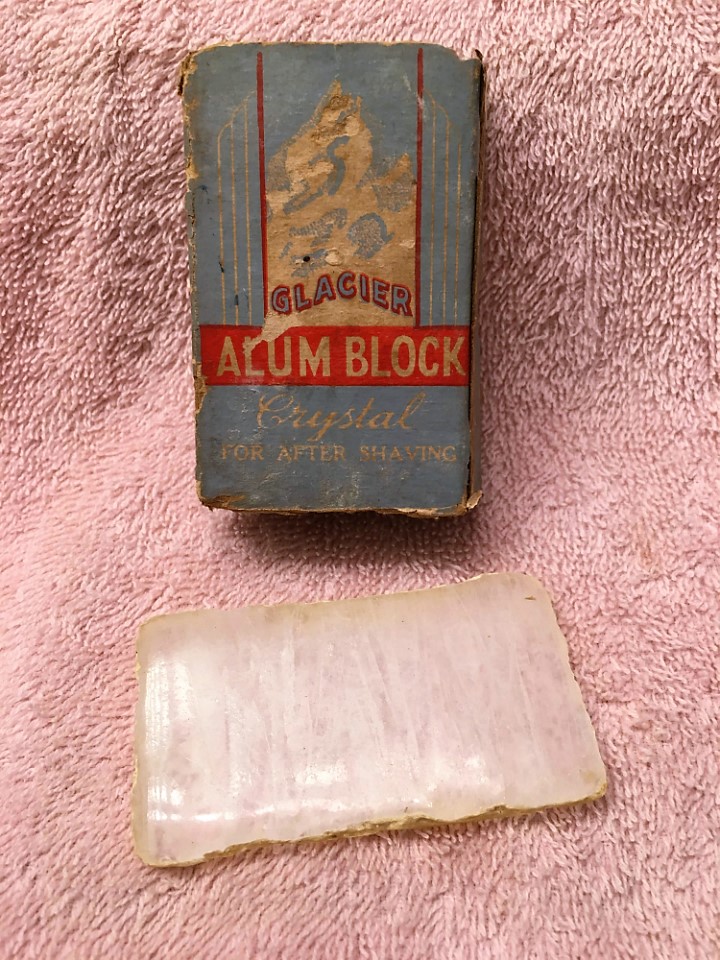
My dad was no stranger to the toilet paper trick, either, but he also kept a solid alum block, which he had purchased from a barber, I couldn’t tell you in what year.  After shaving, you simply run the alum block under cool water and then gently glide it over your freshly-shaven skin. Any nicks, cuts or abrasions will immediately be made known. The alum stings like mad when it finds any such wound, but it does help check the flow of blood. Styptic pencils, used for the same purpose, also contain powdered alum crystals. After my dad passed away, I kept that old alum block, mainly for sentimental reasons, though I have used it from time to time. I wish I’d kept all of the razors as well. Hindsight is always 20/20.

Alum Block

When the time came for me to begin shaving, sometime during my high school years, my dad introduced me to shaving by presenting me with one of his safety razors. This particular one had a “butterfly” mechanism for replacing the double-edged blade and was also adjustable. Twisting a dial built into in the handle would change the height/exposure of the blade, allowing for a milder or more aggressive shave, depending on the setting. This was a good choice for a newbie like me.

We went over the basic techniques—using hot water and the shaving brush to work up a good lather and apply it to my face, holding the razor properly, rinsing thoroughly, using the alum block if necessary, and applying aftershave. My young peachfuzz whiskers never stood a chance. Neither did my face when I began experimenting with more aggressive razor settings over time. But I learned and I did okay.

Before long I became curious about electric shavers and got one of my own. Using an electric razor was cool because I could mow down my whiskers relatively quickly without fear of cutting myself. But they were also bothersome because (a) applying pressure to get a closer shave often resulted in razor burn and (b) the darned things needed to be cleaned regularly. Over the decades that followed, I tried various electric models from Norelco, Remington, Braun, and Panasonic. Some I liked better than others—especially the self-cleaning models, although those tended to break down after the warranty period was up.

Fusion

I also went through all the iterations of disposable and multi-blade cartridge razors, beginning with the Gillette Trac II and culminating with the Gillette Fusion5™ ProGlide Power razor. In the end, I preferred wet shaving, though not necessarily the rising costs associated with using the latest innovations in cartridge shaving technology. Every time the folks at Gillette (now part of Proctor & Gamble) rolled out another iteration of the latest must-have razor, I knew I could count on the cost of replacement blade cartridges going up.

I’d been seeing and hearing a lot about the resurgence of safety razors over the past few years and I guess it was just a matter of time before I got swept up in the movement myself. The cost of blade replacement for my five-bladed (six if you count the trimmer blade on the backside), self-lubricated, vibrating, flexing, pivoting shaving system was between two and three dollars per replacement cartridge and as much as I liked the product, I was ready for a change, if only to save a few bucks. As a rule, I am seldom afraid to try something new. But was I ready to try something old?

This slideshow requires JavaScript.

After a bit of research, I decided to buy The Chieftain safety razor by Vikings Blade. an outfit in Australia that seems to have fun with what they do while taking the art of shaving quite seriously. The product is well-rated and comes with a storage/carrying case as well as five starter blades, all for a price that wouldn’t break me (I was still employed full-time and hadn’t yet broken my shoulder when I bought this). When my new razor arrived, I was not disappointed. The weight and balance are excellent, to say nothing of the fit and finish. The Chieftain is a quality product. I couldn’t wait to try it out.

Hamburger

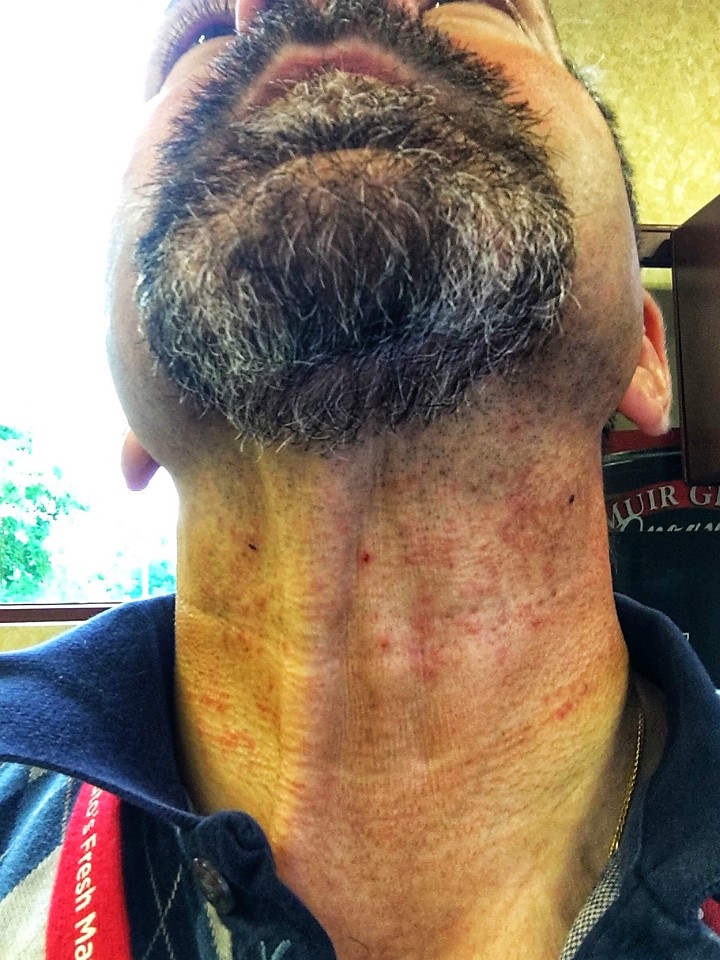
Unfortunately, despite having read and reread the directions and even watched a video or two about shaving with a safety razor, I had built up some bad habits from many years of having shaved with pivoting disposable cartridge razors. Despite the “mild” blade I had used,  my poor neck paid dearly for those bad habits. It was days before I attempted shaving with that razor again, but to be very clear, it wasn’t the razor’s fault. This was pure user error.

I recall one of my college marketing professors, years ago, explaining that The Gillette Company had developed the pivoting razor head after research revealed that a substantial portion of shavers did not hold their razor at the proper angle. The advertisements never said, “…with a new pivoting head, because some of you are too stupid to hold your razors properly,” but that was the gist of it. And remembering that helped me get the best shave of my life with a safety razor. That and an email.

I emailed “Grumpy old Robert” Vue, owner of Vikings Blade, who merely confirmed what I already knew. “Michael, neck shaving with a safety razor is very very different and I can totally guess why you had to use the alum bloc.” He proceeded to give me some sound advice about shaving with a safety razor, which I took to heart. And so, with a healed up neck and a head full of knowledge, I picked up my safety razor and began anew. I even learned a few new things along the way.

If you are looking to make the switch to a safety razor, here are some important tips to keep in mind.

  • Hydration matters. Your skin needs to be very wet, your whiskers softened by it. The result will be an easier shave and more optimal results.
  • Use a proper shaving cream/gel that works for you. I’ll get into my favorite in a bit.
  • A safety razor will not pivot to correct your shave angle, nor will it forgive your mistakes. You must control the blade angle throughout the shave. A 30° angle is considered optimal and you won’t need a protractor to find it. When the portion of the razor head above the blade and the safety bar/comb beneath the blade are both touching your skin, you’re pretty much there.
  • Do not apply pressure on your safety razor for a closer shave! Use the natural weight of the razor and let it glide, at the proper angle, to do its job. Major thanks to Grumpy old Robert for driving this point home for me.
  • Lift the razor off your skin before changing the direction of a stroke or moving the blade sideways.
  • Shaving “with the grain” (in the same direction as your whiskers grow) will yield the mildest shave. Sideways to the grain is more aggressive. Against the grain is most aggressive and will yield the closest shave, if you have the skill and your skin can handle it.
  • Understand your face. There are about three points on the contours of my neck that require additional attention in order to get a close shave without injury. The same goes for the area above my mustache and beneath my nose. Your mileage may vary.
  • Take your time and do it right. If you rush, you may regret it.
  • Sometimes it makes more sense to shave less aggressively, i.e. on a very hot and humid day.
  • No matter what, your last razor strokes should be downward. I was taught that this would train the whiskers to grow downward. True or not, I can’t shake that teaching.

Shaven

My results have been phenomenal. Never again have I suffered the same “hamburger neck” that I experienced with that first, careless shave. I have graduated to using a more aggressive blade—more on that in a moment—and my usual result is an unbelievably close, smooth shave. Any actual nicks have been few and far between, and are usually the result of my zeal to repeatedly achieve the closest possible shave.

Astra Blades.jpg

I place a lot of emphasis on technique when it comes to shaving with a safety razor, but I would be remiss not to mention two other factors, that being your choice of double-edge (DE) razor blade and shave cream—each of which can be a very personal thing. On that fateful first day, when I turned my neck into so much hamburger, I couldn’t see using anything sharper than the “starter” blades that had come with my razor. Several weeks later, I had changed my mind. The Astra Superior Platinum Double Edge Safety Razor Blade is reputed to be among the sharpest-yet-smoothest blades available. These stainless steel, platinum-coated blades are super thin and even after “dulled” by a week or more of shaving, they should be handled with respect. I can get a full two weeks out of one blade, but one week is optimal and at just under ten cents a blade, when bought in 100-count packages, I have little reason to push it. That’s right, I buy 100 premium quality DE razor blades for a fraction of what I used to pay for four disposable Fusion 5 Power replacement cartridges. Some people periodically flip the blade over in the razor head, claiming that doing so extends blade life. Me, I flip the blade after every shave. Even if doing so doesn’t help, it can’t hurt.

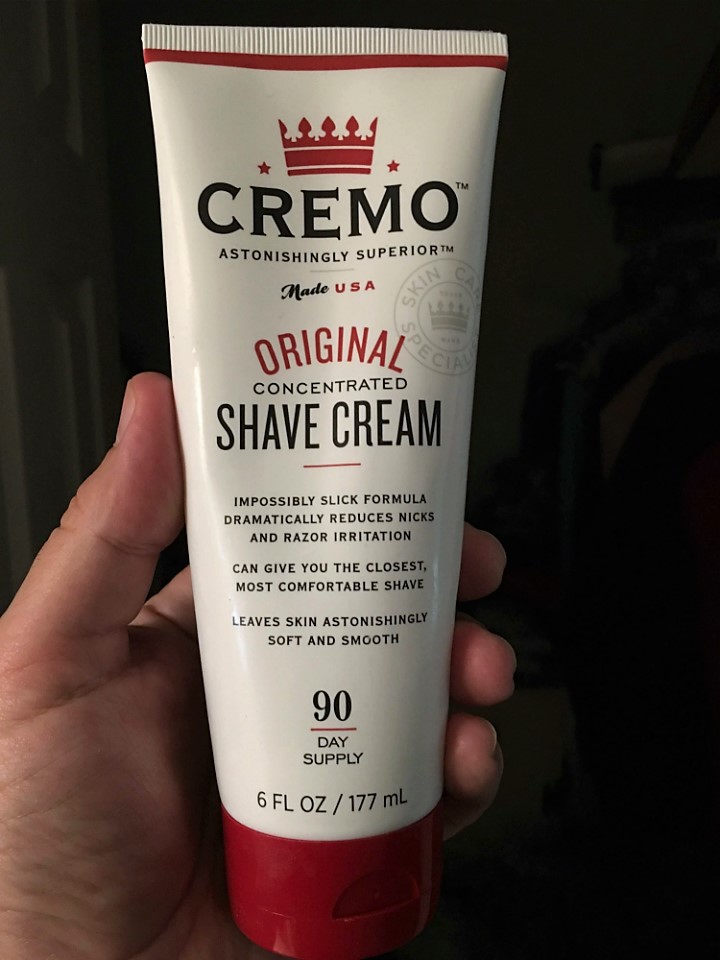
Cremo

Cremo Original Concentrated Shave Cream is my go-to shaving product. I’ve tried others and kept returning to this one. Again, this is a very personal choice, so I encourage shavers to draw their own conclusions. For me, a dime-size dollop plus hot water gets my face as slick as heck and pretty much keeps it that way throughout the shaving process, as long as I can keep it moving with one wet hand. A sufficient coating of Cremo is nearly transparent on my face, which allows me to see what I’m doing and shave with precision.

My son looked at the results I have achieved with a double-edged safety razor and decided to draw his own conclusions. Less than a week later, he opted to get his own Vikings Blade razor, opting for The Chieftain, Odin Edition. I have yet to hear a complaint.

In the end, one’s shaving equipment and accessories are a personal choice. For now, I am very pleased with the choices I’ve made.

Mediterranean Flavors

I had hinted about doing this back when I wrote about our last cooking endeavor (see Cajun-Midwestern Fusion). With spring being a little late to arrive, Ann and I figured we had one more cooking opportunity before riding season really gets underway. So we sorted through countless recipes, favoring Mediterranean influences this time, and selected three dishes to make for our supper (click on each to see the original recipes and ingredients):
Bacon, Avocado, & Brussels Sprout Salad With Lemon Vinaigrette
Chicken Spinach Feta Pie
Roman-Style Stuffed Artichokes

But before we got into that, Ann served up a light lunch that reminded me of the Cajun cooking day we had enjoyed last month. Apparently one of Ann’s local supermarkets had brought in a sizable shipment of frozen, pre-seasoned crawfish. I’d eaten breaded and fried crawfish tails a few times, but neither Ann nor I had never done the break-em-open-and-eat-the innards thing before. She steamed them up and served them with melted butter in addition to a batch of the same spicy remoulade recipe we had made last time. I’m glad Ann and I shared this new and interesting experience together but in all candor, I prefer nibbling the deep-fried tails.

Raw, shredded Brussels sprouts and baby spinach formed the foundation for this particular salad, which we selected because it didn’t share too many ingredients with our other dishes, but also because Ann and I seem to have developed a thing for Brussels sprouts over the past year. We were not disappointed. The combined ingredients deliver big on flavor and textures. In the future, we might depart from the recipe slightly. The avocado seemed to get run over by everything else and so could be considered expendable. And although the lemon vinaigrette was quite good, a poppyseed dressing may complement the flavors even better. To be determined.

What do you get when you combine ricotta, feta, and Parmesan cheeses with spinach, chicken and more, all baked in a phyllo crust? I regret that I didn’t start shooting photos until our chicken spinach feta pie had already been assembled and baked. The preparation is somewhat involved, yet kind of fun. On this one, however, we deviated from the recipe before I had even arrived. Rather than season and pan fry the chicken breasts, I marinated them a day in advance and then grilled them to perfection the night before I drove up to Ann’s place. By doing this, we turned up the volume on that chicken considerably, I think for the better.

Have you ever worked with phyllo dough? We hadn’t, not before this, and we learned something about it in the process. Once you take the sheets out of their packaging, you’ve got minutes to bathe them in butter or otherwise do something before they become as frail and brittle as dry leaves. But when handled properly, there is no substitute for the light, layered, buttery, flaky magic that results.

Given all the stuff that went inside that pie, we really weren’t sure what was going to happen when Ann released the spring-form pan after baking. Would it self-destruct, sticking to the pan and oozing cheese-infused spinach all over the place? Nope. After allowing the contents to cool and set, the entire pie came out intact and retained its shape, even when sliced. The flavor profile was awesome! Just one amendment going forward, the recipe calls for concentric circles of chopped tomatoes, onions, and olives just beneath the top crust. After eating our respective slices, Ann and I agreed that we would combine those three ingredients into a medley, such that the resulting layer delivered a consistent flavor explosion across the entire pie.

I am a fan of stuffed artichoke hearts. My middle sister Anna has made them for years and I have always enjoyed them. Interestingly enough, Ann and I replicated her recipe almost exactly one year prior to our most recent endeavor, with good results. This time around, we wanted to try using fresh, whole artichokes, a daring endeavor to be sure. The results? Whole artichokes make for a more formidable presentation over canned hearts—think large, stand-alone pieces versus a casserole—but what you gain in appearance, you more than lose in labor and waste. Truth be told, my sister’s casserole has better flavor and texture. But again, we wouldn’t know this had we not tried and as always, we had fun throughout the process. There is no substitute for a kitchen filled with love and laughter.

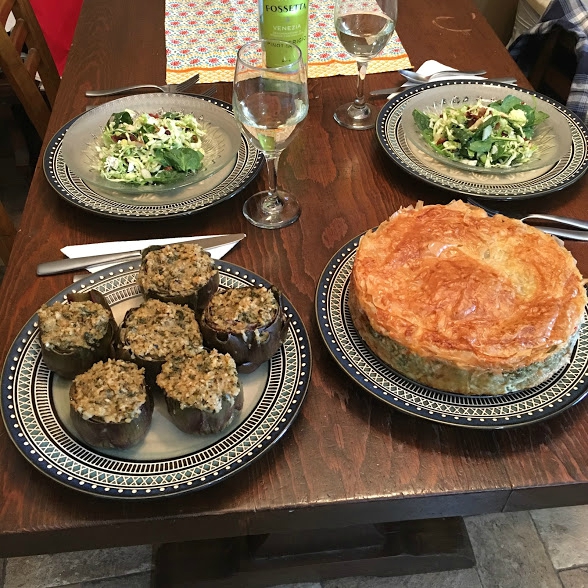
meal

A few final thoughts. First, given the characteristics of this meal, I wanted to select a light-bodied, dry wine to balance it off. We went with an inexpensive Pinot Grigio (Fossetta) from Venice, Italy. Crisp and fruity, yet dry, this wine seemed to serve our needs.

Second, I have presented these three dishes in the order in which Ann and I both enjoyed them most. That salad was our hands-down favorite. It was light and brimming with flavor and texture. Sure, we would change things up a little if and when we make it again, but as built, this first-course dish was just fine. The pie was our second favorite. Plenty of flavors there, even if we hadn’t used grilled chicken (but I’m glad we did). It’s a rich dish, though, and that one pie could have fed up to eight people. Luckily, the leftovers are at least as good as the first time around. The artichokes tasted fine, but in the end, we deemed them to be too labor-intensive for what we got out of them, especially when compared to the tried-and-true casserole version that we’d made before.

Finally, speaking of labor-intensive dishes, all three of these involved a fair amount of cutting, chopping, mincing, grating, etc. That’s not necessarily bad, especially if you enjoy being in the kitchen. But if you are looking for quick and easy meals, these are not the dishes you seek.

It may be a while before you see another “Ann and Michael cooking” post, as once the weather warms up, we tend to go riding when we get together—and I do so enjoy sharing those excursions here. On the other hand, Mother Nature has been a little unpredictable lately, so we’ll just have to wait and see what happens.

Until then, as always, thanks for hanging with me.

Little Cravings—Sopes!
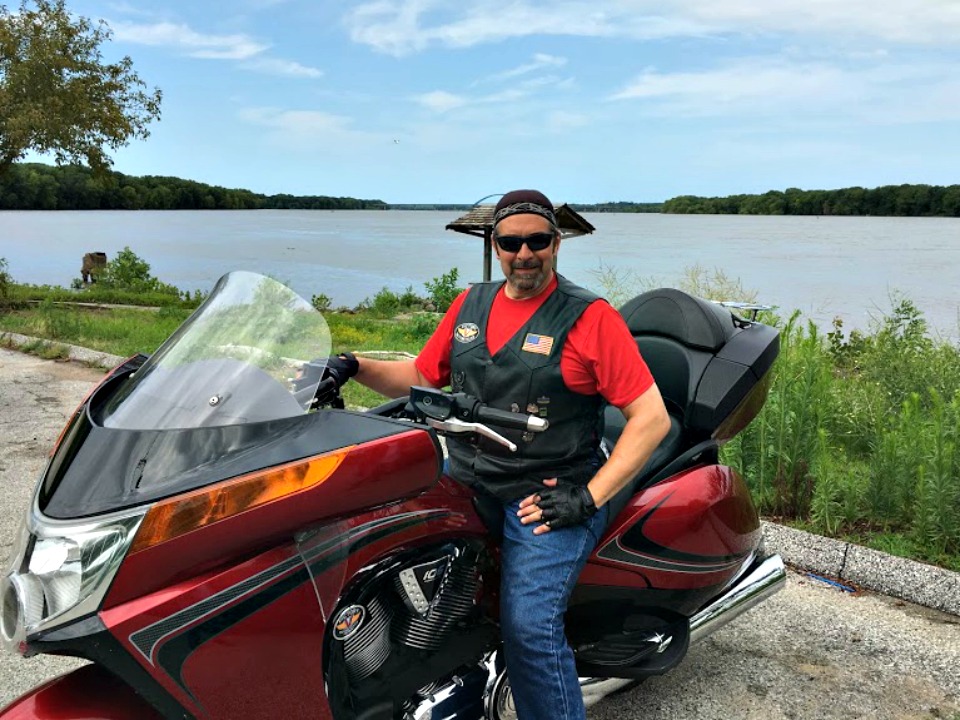
It’s pretty simple, really. You make a stiff corn dough using masa harina, water, and salt. Then you divide that dough into equal portions, each about the size of a golf ball. Now keeping the dough moist by covering it with a wet paper towel, you take each of the golf balls and form it into a flat circle with raised and pinched edges, sort of like a cornmeal petri dish. Then you fry those babies in hot oil until the edges become crispy, but the insides are still soft. The resulting flat corn cakes are called sopes, a type of Mexican street food known as antojitos, which translates literally into “little cravings.” Well let me tell you about the little cravings Ann and I made last weekend, because they were really, really good.

You can put all manner of meats and/or vegetables, plus condiments, on sopes. The raised edges act like a little, non-offensive Mexican border wall that helps keep all the ingredients on top of the little cornmeal disc. Ann and I chose to make green chile pulled pork carnitas, using a pressure cooker. We used a beautiful three-pound pork butt, which we cut into eight pieces and browned, and then cooked under pressure, along with a bunch of tomatillos, green chiles, onions, garlic, herbs and spices.

Mind you, I had never used a pressure cooker before and everything I knew about them I learned from watching television sitcoms, so my biggest fear was not that the meal would turn out poorly, but that we would cause a messy explosion. Ann assured me that my fears were unfounded and all would turn out just fine, as long as we observed a few simple precautions. Of course she was right and everything went as planned, rather than as feared.

This slideshow requires JavaScript.

What went into the pressure cooker filled the pressure cooker. What was left after the lid came off took up a lot less space. The eight portions of pork butt had become so tender, they were already falling apart before I attacked them with two forks. Having given up a lot of liquid under all the heat and pressure, our vegetables were but a collection of mushy solids. And there was indeed a lot of residual liquid in the cooking chamber. This transformation took place in just under an hour, not including cool-down and release. We probably spent more time prepping the ingredients than cooking them. And it was worth every minute. Once that lid came off, the aroma was delightful.

What Ann did next is really cool and ultimately produced the best part of our meal. After removing the chunks of pork for me to pull apart, she strained all the remaining solids from the greasy liquid, stirring and pressing as she filled the strainer. Next, she separated and removed the fat, pouring flavorful greenish liquid into a clean pot. Are you ready for the magic? Ann poured the strained solids into a blender, liquified them, and added the resulting slurry into our broth. Then she cooked the entire lot down into a mild-yet-flavorful salsa verde. This took some time, but again proved to be well worth the wait. A small bit of key lime juice added to the serving bowl was the final touch that made this salsa the best condiment we had.  And we had plenty: homemade guacamole and pico de gallo (“rooster’s beak,” a fresh tomato salsa), several store variety salsas, shredded lettuce, shredded chihuahua cheese, crumbled queso fresco, and crema, a mild-flavored Mexican style sour cream.

Once the salsa had been reduced, Ann fried the sopes on top of the stove while our shredded carnitas, freshly bathed in our salsa verde, were being broiled to browned perfection in the oven below.

It’s not always easy to have the various components of a meal come off in a timely fashion, but this time it did. The table had already been set and every condiment served before Ann began frying the sopes. We didn’t make too many because sopes are best served hot and fresh. The steaming broiled green chile pork carnitas came out of the oven when the sopes were ready to be filled.

And man, did we fill them. Little cravings? Ha! We ate our fill, delighted to agree that we liked our homemade salsa fresca, salsa verde, and guacamole far more than any of the store-bought condiments we had procured. Ann’s son Andy agreed that our endeavor had been successful and once I got home with my share of the leftovers, even my wife Karen, who does not tolerate much spiciness, agreed that our pork carnitas and salsa verde were mild enough, yet so flavorful.

You know what? As culinary efforts go, this was not a labor-intensive meal. As always, there was much animated conversation and laughter in the kitchen, which somehow made our efforts seem more effortless.

I can’t wait to see what we cook up next time. Until then, thanks for hanging with me.